

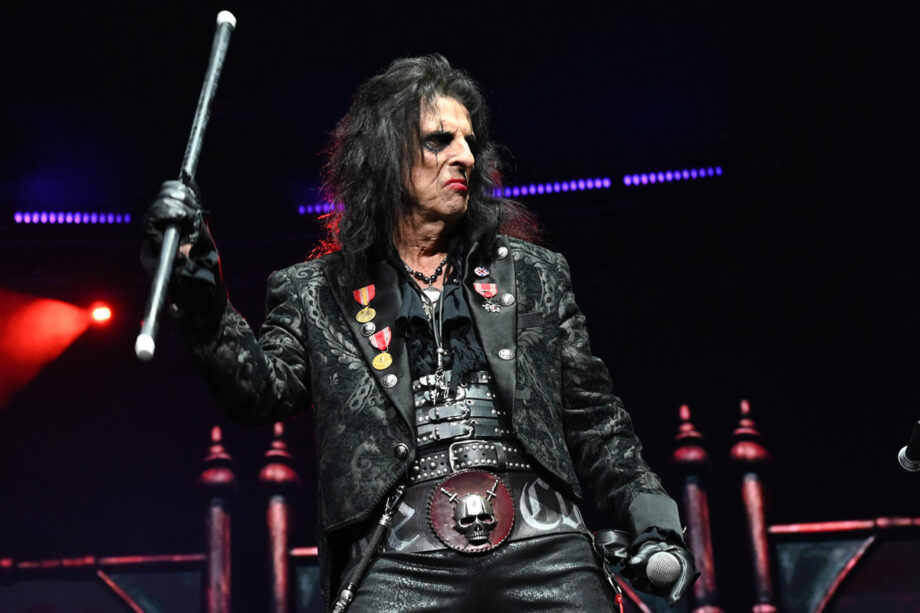
Alice Cooper recently discussed when he plans to retire his shock rock persona, sharing his thoughts in an interview with The Telegraph.
The legendary musician, who turned 78 in February, explained the conditions under which he would step away from performing as his famous stage character.
“Of course, Alice is a fictitious character, so he doesn’t have an age,” Cooper said. “I don’t know how old Alice is, but on stage, he’s the same age he was in 1973. And if I ever look different, if I ever gain 100 pounds, I would never play Alice.”

He went on to emphasize the importance of maintaining the high energy required for his live performances.
“If I can’t do the show with the same energy that I did then, then same thing,” Cooper continued. “I’m never gonna phone it in because it wouldn’t be Alice then. I’m certainly not gonna be on a cruise ship, [singing] ‘I’m 18. And I don’t…’ It’ll be, ‘I’m 80, and I can’t find my shoes.'”
Cooper also compared himself to other veteran rock musicians who continue to tour and perform.

“Rock ‘n’ rollers now — Paul McCartney, The [Rolling] Stones, Rod Stewart — we were lifers,” Cooper added. “And we’re gonna do this till we can’t do it, ’cause I can’t think of a better job.”
Cooper’s comments reflect a career built around a character that has outlived several generations of rock stardom. His shock-rock persona became one of the most recognizable in music, and he has kept that identity central to his live shows for decades.
Vincent Furnier formed the first version of the band in 1964, and the group later adopted the Alice Cooper name as part of its early evolution. Furnier moved with the band to California in 1968, where they took the name Alice Cooper, and the act became best remembered for a shocking stage show that blended the gore of horror films with camp theatricality.
That theatrical approach helped define a new genre. Cooper pioneered a theatrical form of heavy metal performance that fused onstage horror dramatics with a raw, dynamic sound, eventually earning him the reputation as “the godfather of shock rock.” The original band stormed the charts in the 1970s and reached its commercial peak during that era before its members went their separate ways.
The persona’s place in music history was formally recognized more than a decade ago. Alice Cooper was inducted in 2011 in the performer category, with the Hall noting that the act’s psychedelic-tinted music presaged and inspired glam, hard rock, metal and punk. The ceremony took place on March 14, 2011, and Cooper wrapped a snake around his neck while accepting the induction.
That history helps explain why Cooper continues to frame retirement as a question of performance rather than age. Furnier legally adopted Alice Cooper as his own name in 1974, and the character became “my armour” as his stage persona grew more extreme over the years.
The same long view runs through his recent career, which has remained active well into his late 70s. Cooper’s legacy still rests on the combination of hard-rock songwriting and the horror-themed stagecraft that made Alice Cooper a signature live act, a formula he has shown little interest in abandoning.
Our shows are built around the character. Cooper explained the reasoning behind the persona: “The more absurd Alice got, the easier it was to perform.”