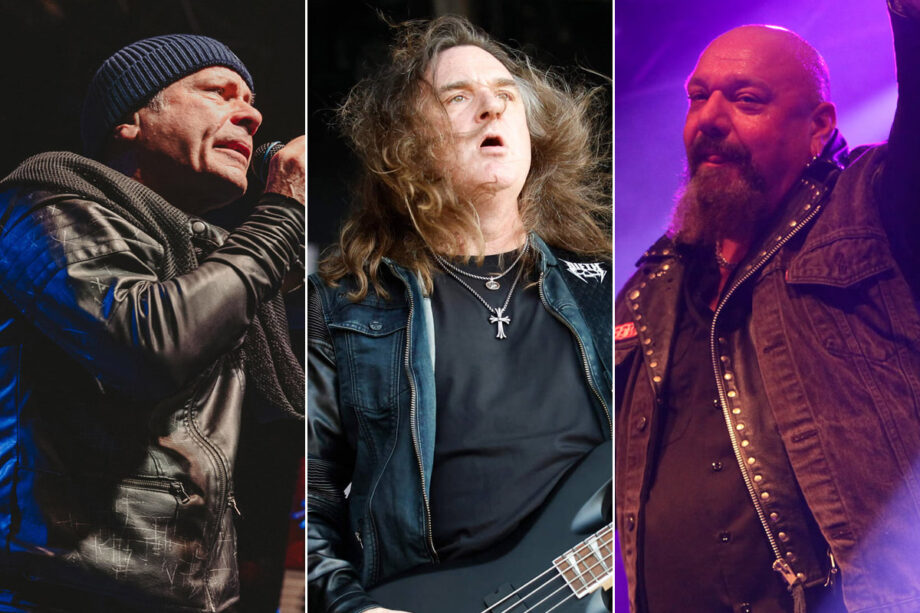
Former Megadeth bassist David Ellefson has aggressively defended Bruce Dickinson against internet backlash over his allegedly awkward final meeting with the late Paul Di’Anno. Ellefson insists Dickinson’s respect was completely genuine. Speaking on “The David Ellefson Show,” Ellefson provided insight into what he believes was a deeply authentic moment between the two Iron Maiden singers.
“I will say my view of it was Bruce Dickinson did that, it seemed very genuine,” Ellefson explained. “When someone dies, it sort of levels the playing field of everything. Any resentment, any fear, any should have, could have, would have—because in that moment, that is just such a real moment, man. You know, the spirit has left the body and there that is it. I mean, that is the end of the story right there.”
Ellefson’s comments reflect a broader understanding of the complex relationship between the two vocalists who shaped Iron Maiden’s legacy across different eras. The meeting between Dickinson and Di’Anno represented a significant moment in heavy metal history. It carried emotional weight for those who witnessed or learned about it.

Bruce Dickinson replaced Paul Di’Anno as Iron Maiden’s lead vocalist in 1981. He stepped into a role that would define the band’s most commercially successful period. While Dickinson achieved unprecedented success with the band, he simultaneously inherited the responsibility of performing Di’Anno’s original material. This task presented its own unique challenges and emotional complexities.
Ellefson acknowledged the peculiar position Dickinson occupied throughout his career with Iron Maiden. “He’s the successor. He got to have all of the success yet at the same time he had to go back and sing Paul’s songs,” Ellefson noted. The former Megadeth bassist recognized that Dickinson’s tenure required him to honor the legacy of his predecessor while establishing his own identity as the band’s frontman.
The original Iron Maiden era, defined by Di’Anno’s distinctive vocal style, created an indelible mark on the band’s early work. Di’Anno’s contributions to Iron Maiden’s first two albums established a sonic foundation that would influence heavy metal for decades to come. When Ellefson heard Dickinson perform Di’Anno’s material, particularly the more intricate vocal passages, it reinforced the irreplaceable nature of Di’Anno’s artistry. “When I would hear Bruce sing the piano stuff, it made me miss Paul because how do you sing Paul’s stuff? He was such an original artist, such an original singer. No one sang like him,” Ellefson reflected.

Paul Di’Anno passed away at the age of 66, marking the end of an era for the metal community. His life revealed a journey marked by both triumph and struggle. The documentary “Di’Anno: Iron Maiden’s Lost Singer” captured not only Di’Anno’s battles with illness and personal challenges but also his remarkable redemption and return to performing. Prior to his passing, Di’Anno experienced a significant reconnection with Iron Maiden. This included a historic face-to-face meeting with bassist Steve Harris in May 2022 at a concert in Croatia. It was the first such meeting between the two in nearly three decades. This reunion demonstrated that despite the passage of time and the changes within the band, there remained a foundation of mutual respect and acknowledgment of their shared history.
Ellefson’s defense of Dickinson underscores a mature perspective on legacy and succession within legendary bands. Rather than viewing the relationship between the two singers as competitive or contentious, Ellefson presents it as one defined by mutual respect. Both artists contributed meaningfully to Iron Maiden’s enduring impact on heavy metal music.