


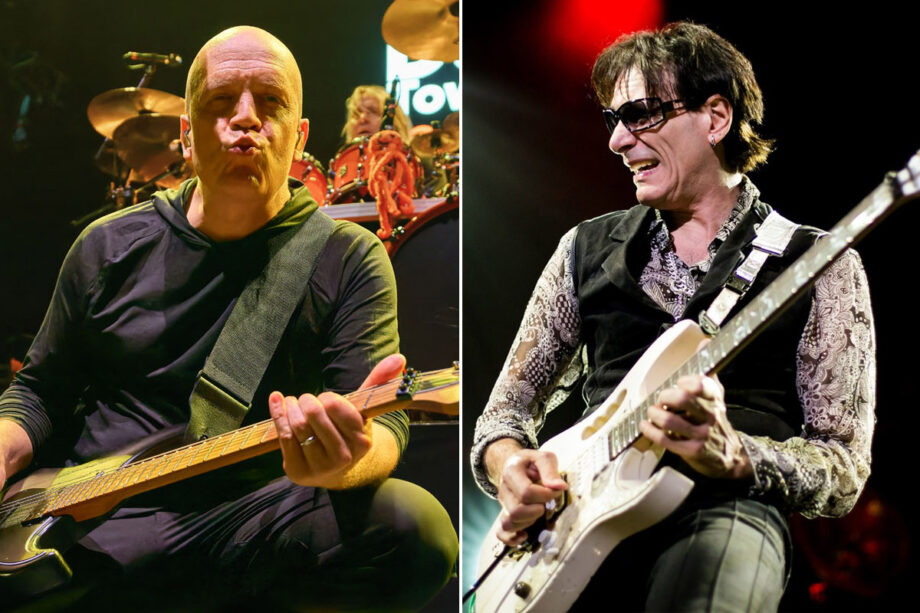
Prog-metal icon Devin Townsend has opened up about a notorious incident from his youth. He infamously defecated in Steve Vai’s guitar case because, at 19 years old, he lacked the emotional maturity and vocabulary to articulate his intense creative discontent with Vai’s rigid lyrical direction.
In a recent interview with the Heavy Stories podcast, Townsend reflected on his time as the lead vocalist for Vai’s 1993 album Sex & Religion. The experience proved deeply frustrating for the young musician, who found himself forced to sing lyrics that held no personal meaning to him. “With Steve, I was only 19 or 20 when I met him, so that petulant part of my personality was in full bloom, right?” Townsend recalls. “When I got there, he was like, ‘I want you to sing these lyrics: sing this song, which is about my wife giving birth, and this song, which is about my experience with this.’ And I remember, at the time, just being like, ‘Man, I can’t!'”
Vai pushed for emotional intensity in performances, demanding that Townsend “really reach for the heavens” on certain lines. The young singer couldn’t connect with material that didn’t resonate with his own experiences. “But it doesn’t mean anything to me,” Townsend explains of his reaction at the time. “I remember reflecting on that experience as being so fundamentally in opposition to how I learned how to write that it wasn’t that I considered it to be wrong, necessarily – and it isn’t wrong, necessarily – but I reacted to it in such a way as a kid that everything in my nature was just like, ‘No!'”

Unable to express his frustration through conventional means, Townsend resorted to an act of crude rebellion that would become legendary in rock music lore. “When you can’t articulate your discontent in a way that is able to be understood in a sitdown environment, I guess you’re left with only the shitting option,” he states bluntly. The incident was Townsend’s way of making an unequivocal statement about his unhappiness with the arrangement.
Townsend’s time with Vai came about through a fortunate convergence of circumstances. Both artists were signed to Relativity Records, and when the label’s A&R representative passed Townsend’s demo tape to Vai, the guitarist was immediately impressed by the young vocalist’s talent. Townsend joined Vai’s fold somewhat reluctantly, recording the album in 1991 or 1992 and subsequently touring for two years. He appeared on high-profile stages with Aerosmith and performed on The Tonight Show. For a teenager thrust into the deep end of the music industry, the experience was overwhelming and disorienting.
At the time, Vai was riding high on the success of his Whitesnake tenure and had achieved genuine rock star status. This stood in stark contrast to the approachable mentor figure he would later become. The power dynamic between the established virtuoso and the struggling young vocalist created an environment where Townsend felt creatively stifled and emotionally unheard. His inability to articulate his discontent in a rational, sit-down conversation left him feeling trapped with no constructive outlet for his frustration.

Looking back with the perspective of three decades, Townsend has made peace with his youthful indiscretion. He acknowledges that the incident was likely confusing for Vai, but maintains that it was the only way he knew how to express his feelings at the time. “I was too young to articulate it in any way that was rational,” he reflects. “At that point, it was a culmination of a lot of circumstances, like arrogance, fame and confusion and relationships. All that stuff. I can forgive myself in hindsight for the ways I reacted at the time because I didn’t know what to do. I didn’t know how to respond. I was lost, right?”
The turbulent Vai experience ultimately catalyzed one of metal’s most significant creative projects. Townsend channeled his frustration and confusion into the formation of Strapping Young Lad, a band that would become his primary vehicle for artistic expression and creative control. Rather than remaining a hired vocalist singing someone else’s material, Townsend seized the opportunity to create music entirely on his own terms. He established himself as a visionary artist in his own right. The incident in Vai’s guitar case, crude as it was, marked a turning point in Townsend’s career—a moment when he refused to compromise his artistic integrity, even if his method of protest was decidedly unconventional.
Remarkably, the relationship between Townsend and Vai has evolved dramatically over the years. What began as a clash of creative philosophies has blossomed into a genuine friendship. The two musicians now maintain a close bond. Vai has publicly acknowledged Townsend’s exceptional talent, and the two have collaborated and supported each other’s work in the decades since their contentious first encounter. This reconciliation speaks to both artists’ maturity and their ability to move beyond the conflicts of youth, transforming a moment of crude rebellion into a footnote in a much larger story of mutual respect and artistic growth.