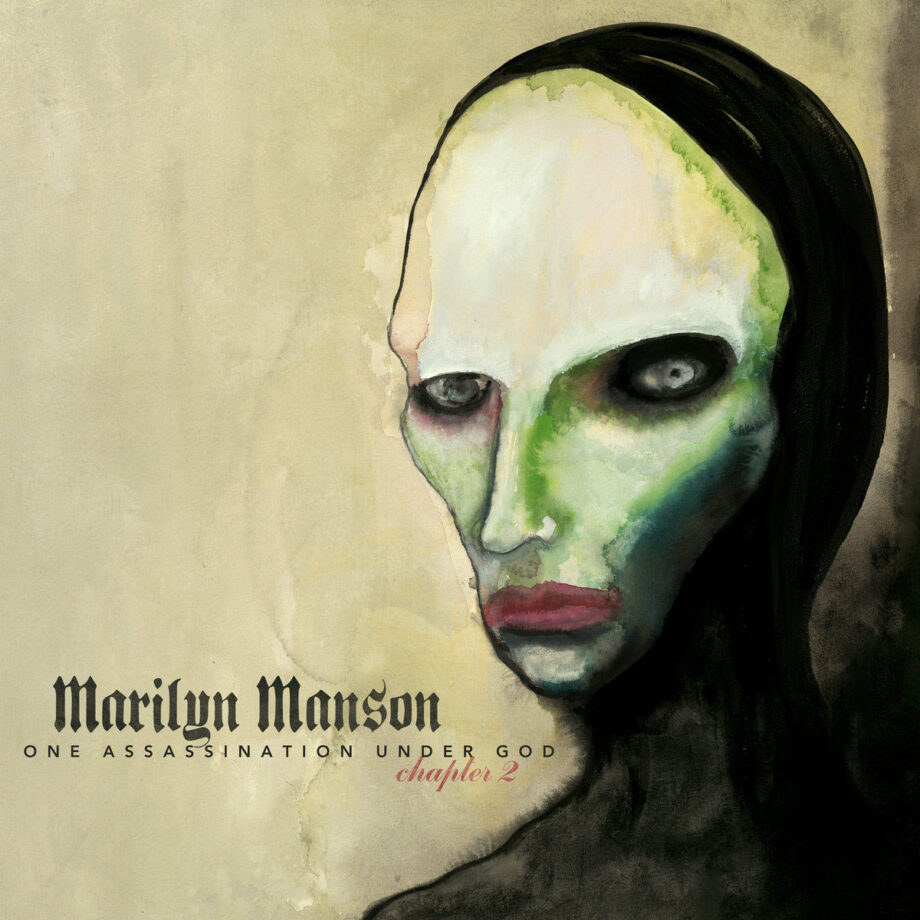
One Assassination Under God – Chapter 2 is a real, newly released Marilyn Manson album, arriving on 14 August 2026 through Nuclear Blast as the second part of the One Assassination Under God project. The record continues Manson’s recent career reset rather than reinventing it, positioning itself less as a comeback statement and more as the next chapter in an ongoing narrative.
The album arrives two years after Chapter 1, extending the story Manson began in 2024. That timing places the record inside a post-comeback phase, where the conversation has shifted from whether Manson has returned to whether he can sustain momentum across a two-album arc.
Chapter 2 plays as the darker, more vindictive half of the project, contrasting with the renewal theme that defined the first chapter. This gives the album a clear identity from the outset: a continuation piece with a narrower emotional focus and a deliberate sense of closure.

The album leans cinematic, compact, introspective, and melancholic compared to its predecessor. Co-written and co-produced with Tyler Bates, it continues the industrial-rock and theatrical metal framework of Manson’s recent work rather than pursuing a stylistic reset.
The nine-song tracklist, with titles like “Unalive,” “Exit Wound,” and “Enantiomorph,” points to a thematically heavy, image-driven record built for atmosphere as much as riffs. The production favors density and mood over maximal aggression, a direction that lands more naturally with industrial-metal listeners than with those expecting straightforward traditional metal.
A stable consensus around the album is still forming, but early readings converge on the same broad take: this is a more focused and self-contained sequel than Chapter 1. The stronger reactions tend to praise the tighter structure and darker tone, while more measured takes center on whether the material pushes far enough beyond the recent Manson template.

The current conversation around the record is less about surprise and more about execution. It reads as a refinement of an existing era rather than a reinvention, a meaningful distinction for a catalog already built on strong visual identity and recurring gothic-industrial motifs.
Reaction to the release has largely treated it as expected but welcome, with attention focused on timing and its role as a direct sequel to the 2024 album rather than a separate era. The overall mood is anticipation mixed with caution, typical of a Manson release cycle: interest runs high, but the sequel still has to justify the concept built around it.
The album is being tracked as a metal release tied to its 14 August 2026 date, though the surrounding reaction data remains thin compared with more established records. That means there isn’t yet a large enough body of response to draw firm conclusions; the fairest read is that the record has stirred curiosity while stronger opinions are still taking shape.
For modern metal and metalcore listeners, the album’s significance lies in how it repackages classic industrial-metal aesthetics for a current audience: concise running time, dark conceptual framing, and polished production tied to a recognizable identity. It isn’t a radical stylistic pivot, so its appeal will likely hinge on whether listeners value atmosphere, narrative continuity, and tone over novelty.
That also explains why the record may resonate more with industrial metal, gothic metal, and adjacent metalcore audiences than with listeners expecting a traditional heavy-metal statement. It reinforces Manson’s late-career identity and stands as a useful case study in how legacy metal artists sustain continuity in the streaming era.