

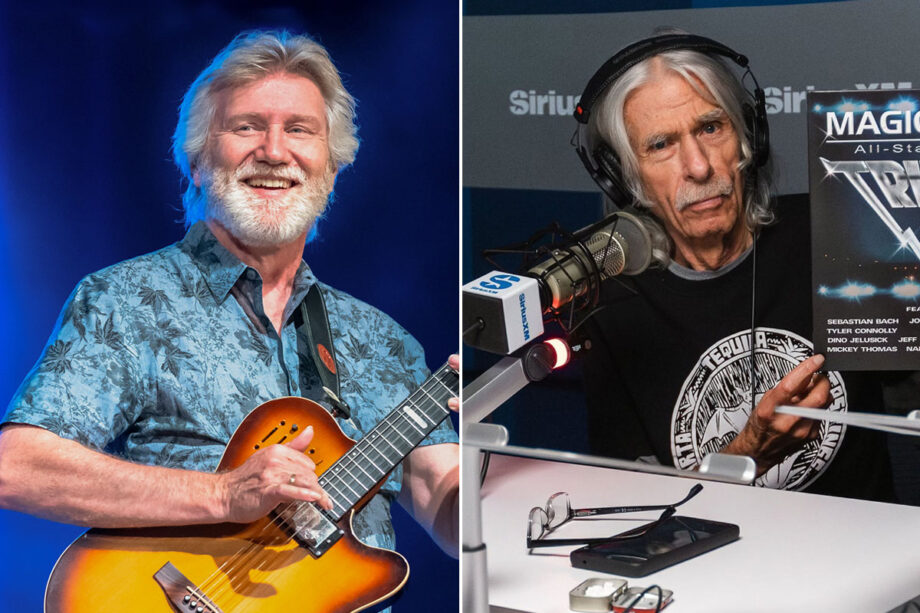
Triumph’s Rik Emmett talked about original bassist Mike Levine not taking part in any of the band’s 2026 tour dates so far after revealing in December that he has a problem with his hand that prevents him from playing properly. Emmett also addressed Levine’s future with the band.
Rik Emmett said, “He didn’t make it out to the actual shows. His son came out and was at some of them, and his grandkid was out at one of them and hanging around and having some fun.
“And Mike — Gil and I saw him last week in the studio. He came out, ’cause there’s a weird thing happening here in Canada where they’re gonna put out a stamp, like a Triumph stamp is coming out by the Royal Mint. And Mike wanted to be at that meeting, man. He didn’t wanna miss that meeting. He wants to be on the stamp.

“So he can travel, and he can move, but I don’t think he can handle what it takes to be on stage. He’s still a little frail, but he’s up on his feet and he’s moving around. He doesn’t need a walker or canes or any of that stuff, and he’s looking pretty good.
“He’d had his mustache shaved off for a bit. It’s grown back in, so he’s not quite back to Sam Elliott territory. But I would say just give it a week — a week or two. And he’ll be looking like his good old self. There’s nobody more hirsute than Mike Levine.”
Levine’s absence is connected to a hand problem that affects his ability to play, although Emmett’s comments suggest the bassist remains involved with Triumph’s activities away from the stage.

Levine said in December, “I have a problem with my hand that precludes me from being able to really play well.” He also indicated that he hoped to perform as many shows as possible.
Triumph was formed in 1975 by Emmett, Levine and drummer Gil Moore. Levine handled bass and keyboards, while Moore played drums and sang, and Emmett played guitar and contributed vocals.
The band released its self-titled debut album in 1976 after signing with the Canadian label Attic Records. The group developed from a marathon jam session involving the three musicians into one of Canada’s best-known rock acts.
Triumph became particularly known for its large-scale concerts and arena-rock presentation. The group built a reputation for “one of the most spectacular live shows ever staged.”
The band’s long history also explains the significance of the planned Canadian stamp mentioned by Emmett. Triumph’s legacy includes major arena-rock successes during the late 1970s and 1980s, while Levine remains one of the three musicians who established the band’s signature lineup.