

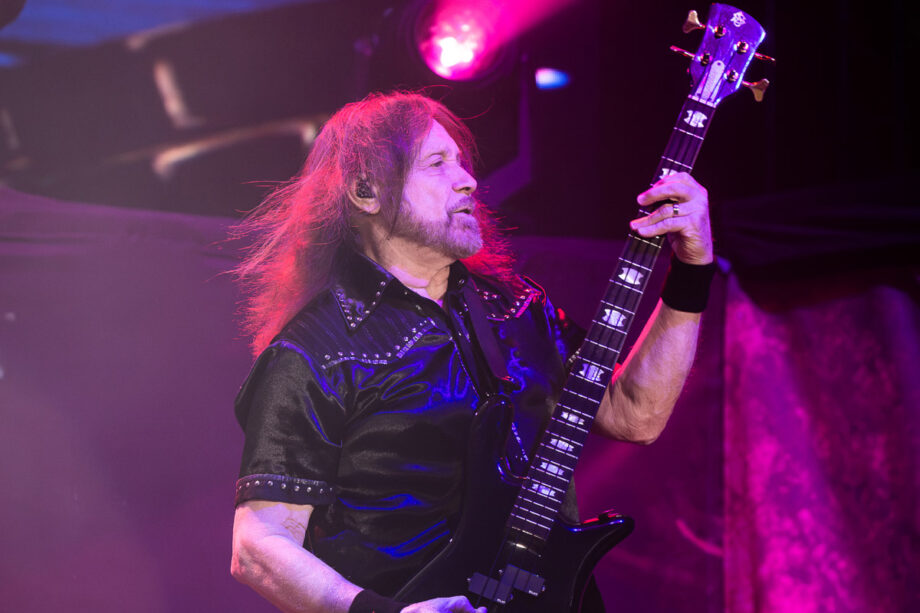
Ian Hill, the longest-serving member of Judas Priest, recently explained the reasons behind his decision to retire from the band, detailing how a brutal touring schedule took a physical toll on him. Hill shared these insights during an interview with Metal Pilgrim.
The bassist discussed his ongoing physical struggles, particularly with arthritis in his shoulder and thumb, which made performing increasingly difficult over his final tours.
“It is funny, because the last couple of tours have been a bit of a struggle, because this trouble is basically my shoulder and my thumb — [I’ve got a] great big lump on my thumb, which is all arthritis,” Hill said. “I’ve been struggling with that for the past couple of tours or so. And it doesn’t go away, unfortunately, and it’s one of those things that just gets worse as time goes by. And I almost retired at the end of the last tour.”

Hill went on to explain how an initially short touring plan escalated into a demanding nine-week run across Europe, culminating in a severe physical injury.
“It’s funny the way it came about,” Hill continued. “Iron Maiden said, ‘Do you fancy doing a four-week tour of America this year?’ And I said, ‘Well, yeah, that sounds okay, a four-week tour of America, quick four weeks.’ Then they pulled out. In the meantime, we’d put in Bloodstock in Britain, which is the festival in Britain. So you can’t tool up to do one show. So the next thing, ‘Oh, we’ll do one or two dates in Europe around Bloodstock.’ And nine weeks later… And that’s what did it. We did six shows in eight days. That was running up to Brussels, so that’s when the tendon snapped. Because we were averaging maybe a day on, a day off, day on, day off, so the crew could get to the next gig and what have you. And, of course, it was recovering on the days off.”
He described the moment his tendon snapped during a performance in Brussels and how he had to adapt physically just to finish the show.

“Obviously, I wasn’t doing anything, so it recovered,” Hill added. “And then, of course, you go on stage and you aggravate it all over again. But then it was sort of, like I say, six shows in eight days, and I’d never had time to recover. And right before the encores on the Brussels show, I just felt a snap and a real sharp, searing pain, and I thought, ‘That’s it. That’s the end of it.’ And for the encores, I had to actually get my elbow and rest it on my stomach and pull the bass back so I could get down to the bottom of the neck.”
Hill also shared an update on his current recovery process and explained how the injury ultimately prevented him from performing at a subsequent show in London.
“And it’s easing off a lot now,” Hill said. “I can sort of lift it and do things that I couldn’t do immediately after that. I mean, I couldn’t move it at all. From the elbow down, everything was fine. It worked a treat, but I just could not move my shoulder. And that’s why I had to miss the London show. I physically could not play the bass.”
Ultimately, Hill felt he had no choice but to retire to avoid putting the band and their tours at risk, while also looking forward to spending more time with his family.
“So I had no choice, really, than to knock it on the head,” Hill explained. “I couldn’t put the rest of the guys in jeopardy and go out on another tour, and it happen all over again in the middle of a tour. It’s not fair on anybody — the fans, the rest of the guys, the people have put money into us to get us out to these places, and suddenly you’re having to cancel shows and things. It’s not fair. So I decided to call it a day, and I have. I’ve neglected family life. It’s cost me two marriages over the years. So I decided to spend a bit of time with the folks.”
The decision closes a chapter that spans more than five decades, making Hill’s exit one of the most significant line-up changes in Judas Priest’s history. His tenure and the circumstances surrounding his departure add important context to the story he shared with Metal Pilgrim.
Hill joined Judas Priest in 1970 and played on every single one of the band’s 19 studio albums, from Rocka Rolla in 1974 through Invincible Shield in 2024. He formed the band with schoolmate K.K. Downing in 1969 and remained the sole surviving member of the Birmingham metal legends’ embryonic line-up until his retirement.
The official announcement came on Oct. 9 and took effect immediately, with Hill citing an advanced battle with arthritis. Hill described his condition as “the onset of the evil arthritis,” which he said had reached an advanced state in his left shoulder and right hand. In the band’s statement, he also wrote: “This was due to me snapping a tendon in my left shoulder (as if I didn’t have enough problems with it!) just before the encores during the Brussels show two days before.”
That injury had an immediate impact on the band’s live schedule. Hill missed Judas Priest’s London performance at the Eventim Apollo on Sept. 21, the first show he had missed since joining the group. Uriah Heep bassist Davey Rimmer filled in for him at the London date and was later confirmed as Judas Priest’s new bassist.