

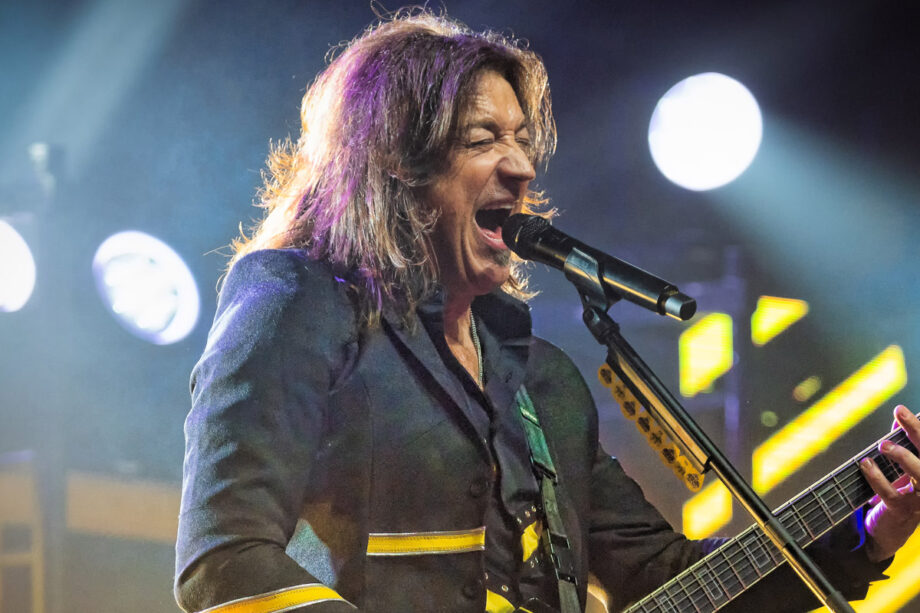
Stryper frontman Michael Sweet has publicly criticized rock musicians who use live concerts as platforms for political messaging. He argues that alienating paying fans is both ethically wrong and a poor business decision.
In a Facebook post that sparked considerable debate, Sweet urged rock stars to prioritize unity over divisiveness. “Write songs that bring people together. Songs that tear down walls. Songs that unify. Songs that inspire both sides to do better,” Sweet wrote. “Instead of tearing down the other side, encourage the people who pay to watch you perform. Who buy your albums. Who watch your videos. Who invest in your music.”
Sweet’s message resonated with some fans. However, it drew pushback from others who argued that artists have the right to express their political beliefs. One longtime listener responded: “Michael, I’ve listened to Stryper for 40 years. I love your music. Nonetheless, if someone wants to take a stand on something, it’s their choice to do so, whether it be a rock star or a janitor.”

Sweet doubled down on his position, emphasizing that his concern was not about free speech but about the consequences of divisive messaging. “When rock stars get on stage and divide the country and disrespect 50% of the country who are buying their albums and buying their tickets to go to the shows, why do you want to get up on stage and alienate half of your fan base?” he asked. Sweet revealed that he has personally stopped listening to artists whose political messaging conflicts with his values. He described the practice as “shooting yourself in the foot.”
The debate highlights a broader tension in the music industry between artistic expression and audience retention. Sweet’s comments reflect a philosophy centered on unity and inspiration rather than confrontation. This stance has defined much of his career with Stryper.
Michael Sweet’s public messaging has consistently been rooted in faith and spirituality rather than conventional partisan politics. MetalSucks reported that Sweet has framed Stryper’s identity as a band fundamentally grounded in belief in God. He positions the band’s mission as one of spiritual uplift rather than political advocacy. This faith-centered approach distinguishes Sweet’s perspective from typical left-right political discourse. Instead, it emphasizes values that transcend partisan divides.

Sweet’s emphasis on unity and inspiration aligns with his broader artistic philosophy. Rather than engaging in conventional political debates, he has consistently advocated for music that uplifts listeners and encourages positive change. This approach reflects his belief that the most powerful role musicians can play is to inspire hope and foster connection among diverse audiences, regardless of their political affiliations.
Metal Injection noted that Sweet has emphasized Stryper’s commitment to authenticity and resilience throughout the band’s career. Sweet has stated that the band has “nothing to prove” and has already “broken all boundaries” in its own lane. This reflects a philosophy of staying true to their mission rather than chasing mainstream approval or engaging in divisive rhetoric.
This commitment to authenticity extends to Sweet’s recent interviews and public statements. Rock Music Star documented that Sweet’s mission remains clear: to inspire, uplift, and challenge listeners on a deeper emotional and spiritual level. Rather than using the stage as a platform for political confrontation, Sweet views his role as an artist to create meaningful connections with audiences. He encourages them to feel something profound through music.
Sweet’s recent comments come at a time when many musicians face increasing pressure to take public political stances. Metal Mayhem Rock revealed that Sweet has consistently positioned himself as an artist whose primary responsibility is to his audience’s emotional and spiritual well-being rather than to any political agenda. This perspective reflects a generation of musicians who built their careers on the principle that music’s greatest power lies in its ability to unite rather than divide.
Sweet’s stance suggests that the most sustainable approach to a music career is one that prioritizes the broadest possible audience connection. By refusing to alienate segments of his fan base through divisive messaging, Sweet has maintained Stryper’s relevance across decades and multiple generations of listeners. His recent comments serve as a reminder that in an increasingly polarized world, the choice to build bridges rather than walls remains a viable and perhaps more profitable artistic strategy.