

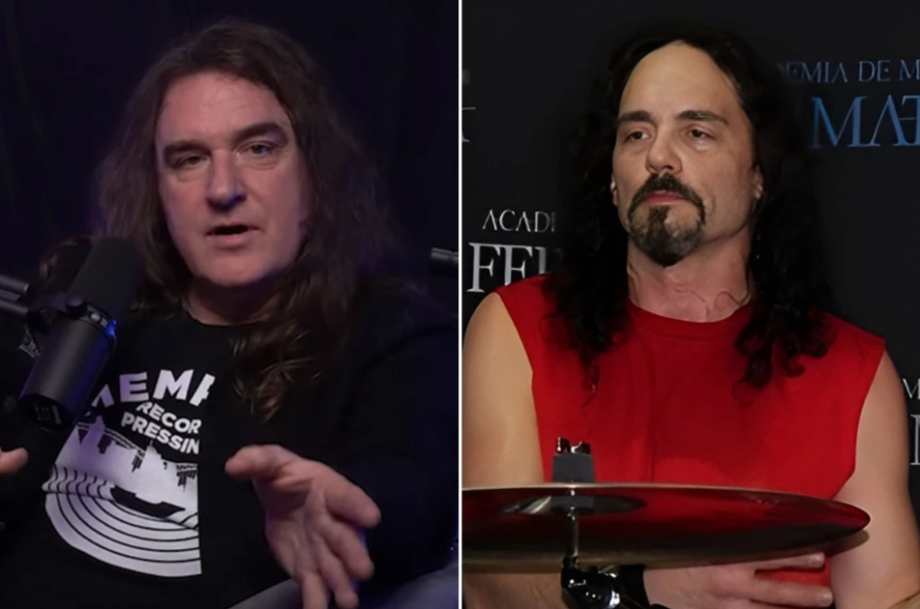
David Ellefson recently offered insight into the events that led to drummer Nick Menza’s exit from Megadeth, revisiting a crucial moment during the band’s 1998 touring cycle. Speaking on the David Ellefson Podcast, the bassist reflected on a show at Mesa Amphitheatre on June 6, 1998, shortly before Megadeth was set to join Ozzfest.
According to Ellefson, it was during that performance that he realized Menza was struggling. The drummer appeared worn down and unusually disengaged onstage. “We were on a short little run of dates, and then we were going to go right into Ozzfest ’98,” Ellefson said. “Which was big, obviously. We played the Mesa Amphitheatre, which was hometown for Megadeth. And I remember there was a moment during ‘In My Darkest Hour’, there’s these little breaks. And I’d go back to Nick, and we’d kind of rock out together. And I went back there…and he was sleeping most of the day. He wasn’t really ‘alive’ on stage in his normal fashion. It was laborious in effort.”
Seeing Menza struggle that night led Ellefson to conclude that continuing with the same lineup could jeopardize the band’s upcoming tour. With Ozzfest looming, he felt a difficult decision had to be made to protect the band’s momentum.

“I went back to Nick and he just was not there. In fact, I remember he’s playing, he kind of looked over at me like, ‘What are you doing here dude?’ And I was like, ‘Oh shit.’ Now, all of a sudden, I was going, ‘You know what? We got to make a change. This is gonna be a bad summer if we go like that,’” Ellefson continued. “And that’s not to shame Nick in any way. Things happen that way.”
Beyond what was visible onstage, Menza was also dealing with serious health concerns. Ellefson explained that the drummer was coping with knee issues and the stress of an uncertain medical outlook at the time.
“This hits drummers first and the hardest,” Ellefson noted. “Nick has talked about that we even talked about it in this documentary movie that we did, and his sister Donia weighed on it too; he had problems with his knee. He thought it might be cancer, because there was a diagnosis done that he needed to come in for some more X-rays and stuff. So there was stuff weighing on him.”

Menza’s departure was ultimately shaped by more than just performance difficulties. According to Blabbermouth, he underwent surgery later in 1998 to remove a growth from his knee, which doctors initially feared could be cancerous before determining it was benign.
The medical scare unfolded at a critical moment, as Megadeth was preparing for an intense summer touring schedule. The circumstances surrounding his exit remain disputed. Ultimate Metal reported that Menza claimed he was fired by Dave Mustaine while still hospitalized, just two days after his surgery—an account that contrasts with the idea of a more mutual or performance-based decision.
The split marked the end of what many fans consider Megadeth’s classic era. As noted by KQED, Menza was a key member of the band during its most acclaimed stretch from 1989 to 1998, contributing to some of their most influential albums. Following his departure, Menza explored jazz music and developed a passion for woodworking. He died in 2016 after collapsing onstage during a performance.
Ellefson’s recent comments add further nuance to a long-debated chapter in Megadeth’s history. While he stressed that the choice was made with the band’s future in mind, the broader context shows a drummer grappling with physical strain and serious health fears during one of the most demanding periods of his career.