

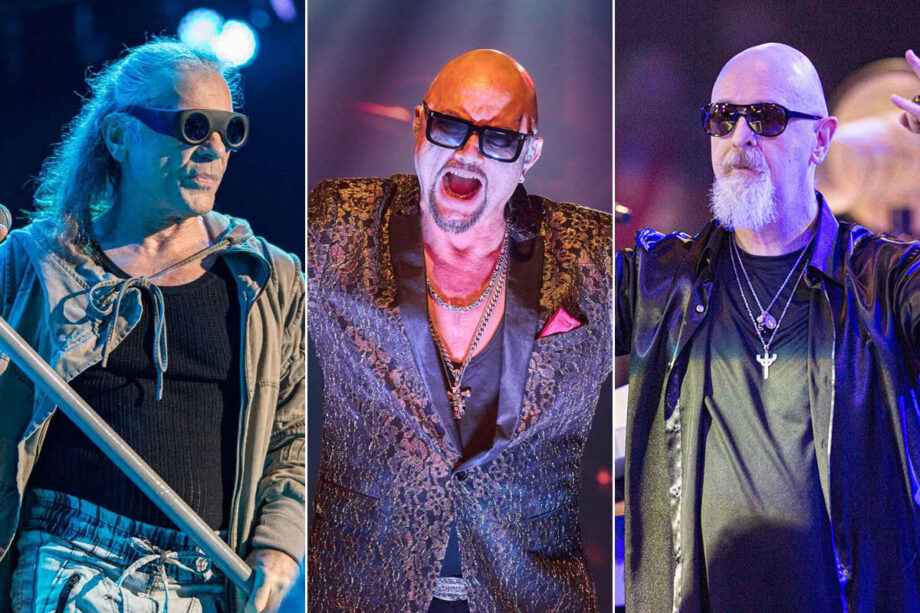
Former Queensrÿche singer Geoff Tate has opened up about the highly anticipated but never-materialized ‘Three Tremors’ supergroup project with Iron Maiden’s Bruce Dickinson and Judas Priest’s Rob Halford. The ambitious collaboration simply couldn’t overcome the practical challenges of coordinating three of metal’s biggest names.
“Not far at all. I don’t know what was happening in Bruce’s mind at the time, or Rob, what was going on with him,” Tate explained. “But, yeah, from my perspective, it didn’t progress very far at all. We were all busy doing different things, and it was impossible to get us all in one place.”
The revelation sheds light on one of heavy metal’s most intriguing “what-if” stories. A project that captured fans’ imaginations ultimately remained unrealized due to scheduling conflicts and competing commitments.

The concept of The Three Tremors emerged during the early 2000s when the three legendary vocalists found themselves touring together. Iron Maiden manager Rod Smallwood pitched the idea after drinks, cleverly dubbing it “The Three Tremors” as a heavy metal nod to The Three Tenors—the famous classical crossover project. Demolish Magazine documented this origin story. The name itself reflected the ambition of bringing together three titans of metal in a way that would create something greater than the sum of its parts.
The vision was genuinely compelling: three of metal’s most distinctive and powerful voices—Tate’s operatic range, Dickinson’s soaring delivery, and Halford’s commanding presence—united in a single project. Blabbermouth reported that the project was even briefly considered for renaming to “Trinity” to avoid potential legal issues. However, the fundamental problem remained: getting three busy international rock stars in the same room at the same time proved nearly impossible.
Despite the logistical challenges, the project did move beyond mere conversation. Bruce Dickinson traveled to Los Angeles to write three songs with producer Roy Z. Loudwire’s coverage revealed that the goal was to create tracks specifically designed for three distinct voices rather than simple verse splits. Dickinson was particularly enthusiastic about the collaboration at the time. He drew inspiration from Tate’s work on Queensrÿche’s landmark album Operation: Mindcrime.