


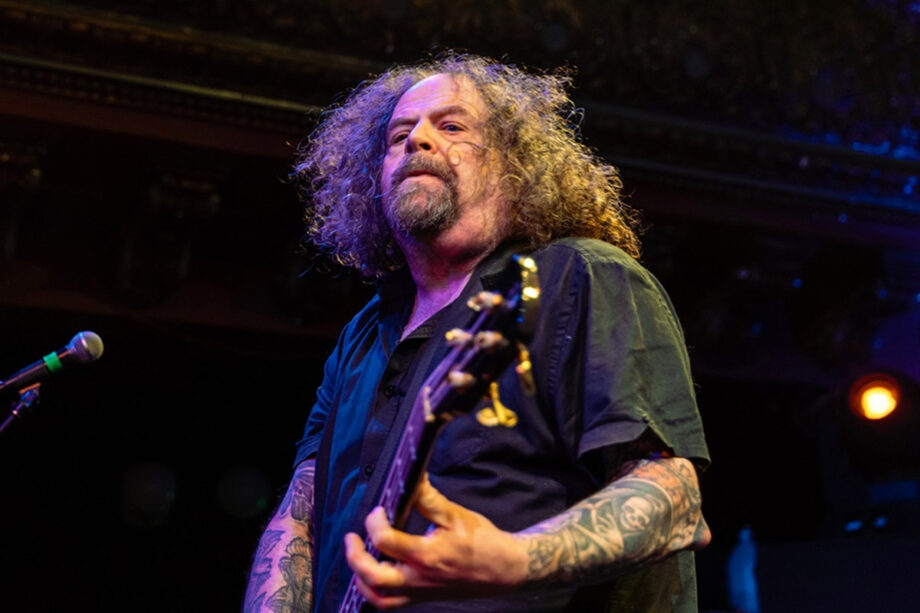
Shane Embury, the longtime bassist of legendary grindcore pioneers Napalm Death, has opened up about a harrowing health crisis that forced him to abandon a tour with The Melvins last year. In a candid interview, Embury revealed that he battled severe alcohol-induced pancreatitis and burnout. These conditions nearly claimed his life and prompted a complete reassessment of his lifestyle and career priorities.
Embury has experienced pancreatitis multiple times throughout his life. “I’ve been on and off probably for a long time. My health’s been generally okay. I’ve been very lucky, really, because I’ve had what they call pancreatitis. I’ve had that, like, three times in my life at various stages, and I’ve been hospitalized three times,” he explained. “And [I’ve been] quite lucky to bounce back as I have done.”
The bassist’s struggle with pancreatitis stems from years of heavy drinking. He initially downplayed the severity of his condition despite its serious consequences. “I developed pancreatitis through drinking. You don’t like to think that you’re a, quote-unquote, alcoholic. You go, ‘Ah, no, I’ve got a handle on it.’ You think you have because you go on tour and you come back, and then you switch it off. I hadn’t drank for a long, long time. But the last few years, it kind of crept back in again, and loads of other different issues were going on for me,” he said.

The crisis reached a breaking point during the Melvins tour. “Last year was pretty hardcore on the Melvins tour. I got about three weeks into it and I had to leave. It could have gone really bad,” Embury recalled. The decision to step away from the tour marked a turning point in his recovery journey. This experience led to significant improvements in both his physical and mental health.
Embury’s recovery has been multifaceted, combining traditional support systems with psychological introspection. He attended Alcoholics Anonymous meetings for the first time, an experience that proved transformative in his understanding of himself. “I went to some AA [Alcoholics Anonymous] meetings, which I’d never done before, and I found that kind of interesting from multiple perspectives of listening to them talk and reading The Big Blue Book, as they call it. And [I went], ‘Okay, I recognize myself in these pages,'” he shared.
Beyond AA, Embury has embraced Jungian psychology as a framework for deeper self-examination. This approach has allowed him to explore the psychological underpinnings of his destructive behavior. He examines concepts such as the inner shadow and ego. “I’m also kind of into my Jungian psychology, which is an ever-learning experience. You can’t sort of take it, quote-unquote, for you, because every person’s different. But the whole looking at your inner shadow and your persona, and the ego and various things. So together, with the AA, I felt a bit more armed this time towards trying to work it out,” he explained.

The bassist’s self-reflection revealed uncomfortable truths about his touring schedule and personal motivations. At one point, he was juggling multiple bands simultaneously. He pushed himself to unsustainable limits. “At one point I was touring with four or five bands, just pushing, pushing, pushing, pushing. And I think sometimes you get burned out. And sometimes your body has to tell you — maybe — or your inner spirit or whatever. But if you try to ignore it, it will knock on you and go, ‘Look,'” Embury noted. This realization prompted him to fundamentally reassess his commitments and priorities.
The support from his Napalm Death bandmates proved crucial during this vulnerable period. “The Napalm boys, they’re very supportive. They were worried about me. They probably didn’t wanna wake up and find me dead in the bunk,” Embury acknowledged. He recognized both their concern and the gravity of his situation. His recovery has positioned him in a significantly better place mentally and physically compared to the previous year. This demonstrates the effectiveness of his integrated approach to healing and self-discovery.