

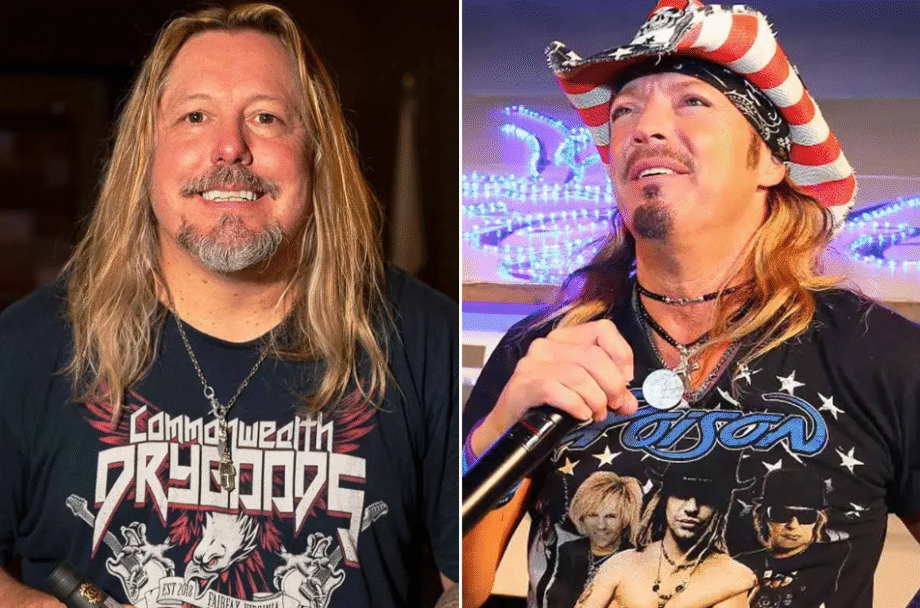
Pete Evick recently discussed the financial structure within the rock band Poison, addressing widespread misunderstandings about how the group’s income is divided. His comments appeared on The Hair Metal Guru.
Evick clarified that, contrary to common belief, Poison’s earnings are not split equally among all four members. Instead, Bret Michaels receives a larger portion of the band’s revenue under a negotiated deal that reflects his frontman role. “You had mentioned why wouldn’t Brett play solo and keep the portion of the money as opposed to splitting it four ways,” Evick explained. “The truth of the matter is he doesn’t split that money four ways of Poison. He does get the lion share of that because he’s worked that out in his deal because he’s the one carrying the torch.”
He went on to note that this pay structure is common across the music industry and not unique to Poison. “A lot of people have this misconception. I call it the Bon Jovi theory. Because when I was a kid, I fell for it. I believe that Bon Jovi were all best friends and that they were splitting everything four ways and they were going to live happily ever after in a neighborhood together. It’s just it’s just not true,” he said. “Any job in any business, someone gets paid more than someone. There’s hierarchy.”
Evick added that Michaels’ larger share is warranted, given his constant work ethic and solo success. Other members of Poison do not maintain the same year-round schedule.
“Brett gets mad when I say this. But I’ve already said it a million times. He deserves that. Rock of Love, The Apprentice, just staying out there. Even the solo band itself, cuz Brett’s a year round guy. We don’t stop playing. It’s non-stop,” Evick noted. “And the Poison guys don’t want to do that. CC doesn’t want to play, you know, Thursday, Friday, and Saturday all year long.”
Despite these financial differences, Evick emphasized that the band’s relationships remain amicable and professional. “The Poison politics are intense and unique and would be a smash hit movie or a smash hit reality show in itself. However, it’s not punching each other out. It’s cordial. It’s business. No one’s fighting with each other. No one’s hating each other. There’s no stupid childish rock and roll drama. But there is a lot of politics to get those four on that stage together,” he concluded.

Poison’s financial success can be traced back to key early decisions in their career. One of the most significant, as reported by Blabbermouth, was retaining ownership of their publishing rights. Michaels has described this as “the biggest gem” for the band, explaining that it became the cornerstone of their long-term wealth.
When reviewing their initial contracts, Michaels was shocked at the poor terms offered—earning just a dime for every 36 million records sold. Refusing to accept those conditions, the band chose to retain ownership of their music, a move that paid off immensely over time.
This decision allowed Poison to profit directly from their catalog’s continued popularity. According to Metal Head Zone, Bret Michaels is the wealthiest member of the group, with a net worth of $20 million, while lead guitarist C.C. DeVille has amassed around $8 million. These differences reflect not only their roles within the band but also their independent ventures and songwriting contributions, which typically yield higher royalties.
Poison’s overall commercial success has been remarkable. As reported by American Songwriter, the band has sold over 40 million records globally since forming in 1983. They reached their peak between the mid-1980s and mid-1990s with multi-platinum albums such as Look What the Cat Dragged In, Open Up and Say… Ahh!, and Flesh & Blood. Touring has also remained a major income stream, highlighted by their participation in the highly successful 2022 Stadium Tour with Def Leppard and Mötley Crüe.
Beyond the band, Michaels has significantly expanded his fortune through a prolific solo career, releasing albums like Songs of Life (2003), Freedom of Sound (2005), Custom Built (2010), and Jammin’ with Friends (2013). As of 2025, he continues to build on this success with the Parti-Gras 2.0 tour, featuring multiple venues and guest appearances.
The combination of retained publishing rights, sustained touring income, solo releases, and diversified business ventures has created a highly profitable financial structure for both Michaels and Poison—corroborating Evick’s remarks about why the frontman commands a larger share of the band’s earnings.