

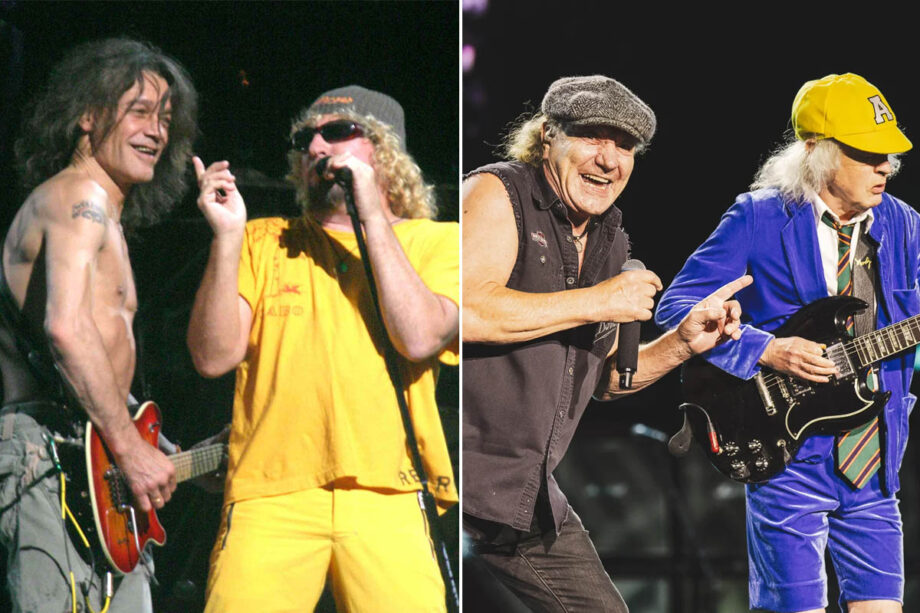
Former Van Halen singer Sammy Hagar recently explained the “No AC/DC” rule during his Van Halen years, discussing the band’s impressive live performances in an interview shared on Bon Scott YouTube.
Hagar recalled how he first became a fan of the band after hearing their music on the radio and later witnessing their powerful stage presence firsthand.
“I heard AC/DC on the radio before I ever knew any of the guys, and I just remember hearing ‘Problem Child’,” Hagar said. “And I just… That song, I just loved that song. I just thought it was just the coolest song. It was just so edgy and just the way he sang. I became an AC/DC fan instantly.”

He then described seeing AC/DC open for his former bandmate Ronnie Montrose in San Jose, California, in the mid-1970s.
“I just left a band called Montrose, which was this early ’70s metal, hard rock band,” Hagar continued. “And when I went solo, Ronnie Montrose went and did an instrumental thing. He broke up the hard rock band — we were like the American Led Zeppelin-type band — and he went out with the instrumental thing with a song called ‘Town Without Pity’, played on guitar, no singers, and AC/DC opened up for him in our hometown of San Jose, California. And I went to see AC/DC. Ronnie had fired me, so I was just trying to start a new band. And so this must have been, like, ’75, ’76 at the latest. And it was AC/DC’s first time over here, I think, and they opened for Ronnie, and they killed it. I’m just going, ‘Oh, my God.'”
Hagar went on to describe how AC/DC’s energetic performance completely overshadowed the headlining act.

“I went to see AC/DC, and, of course, I was talking to Ronnie, but Angus got on Bon’s back, and he went through the audience,” Hagar added. “I mean, they just ruined it [for Ronnie]. It was a small place, about 2,000 people, and Ronnie was getting ready to go on. I said, ‘Ronnie, you want me to come out and sing ‘Bad Motor Scooter’ or ‘Rock Candy’ or something with you? ‘Cause, dude, you’re gonna have a hard time.’ And he just… It was horrible. I had to leave in the middle of his show. It was embarrassing.”
He concluded by explaining how this experience led to a strict rule during his time with Van Halen regarding sharing a stage with AC/DC.
“AC/DC did that to everyone,” Hagar explained. “Anytime they opened for someone, you were in trouble. Later on in Van Halen, when everybody had already made it in big time, we used to get offered festivals with AC/DC, and they did it one time before I was in the band in Europe. And we always said, ‘No, no, no. We don’t even wanna be on a show with AC/DC. I’ll pay money to go see AC/DC, but we don’t wanna be before them. We don’t wanna be after them.'”
This rule ensured that Van Halen avoided the difficult task of following AC/DC’s legendary live sets. Hagar’s story also connects to a much longer history between the two camps, stretching back to his earliest days as a frontman and to AC/DC’s first trips to the United States.
Hagar’s link to Ronnie Montrose began well before his Van Halen era. Hagar discovered that guitarist Ronnie Montrose was forming his own band and began singing for Montrose in the summer of 1973. Before the end of that year, the group released its self-titled debut on Warner Bros., an album that helped establish Hagar as a national rock voice.
That debut record carried two of the songs Hagar mentions in his AC/DC story. “Bad Motor Scooter” was released on Montrose’s 1973 debut album and, along with “Rock Candy,” remains one of the band’s best-known songs. Both tracks later became staples of Hagar’s solo sets. The 1973 album introduced Hagar’s voice to a wider audience through songs including “Rock Candy,” “Bad Motor Scooter,” and “Make It Last.”
AC/DC’s early American touring also ties directly into that Montrose period. The band played San Jose, California, during its 1978 “Powerage” U.S. tour, with Ronnie Montrose listed as the supporting act. A fan recollection on that page captures how the young band fit into that bill: “I was going to a Ronnie Montrose concert, and they just happened to be the opening band.”
Hagar’s own path eventually led him to Van Halen, where the memories of that night shaped his touring decisions. Hagar joined Van Halen in 1985 following David Lee Roth’s departure, and Eddie Van Halen’s appreciation of Montrose was cited as part of the background to the hire. That shared history gave Hagar a firsthand reason to keep his distance from AC/DC on any festival lineup.