


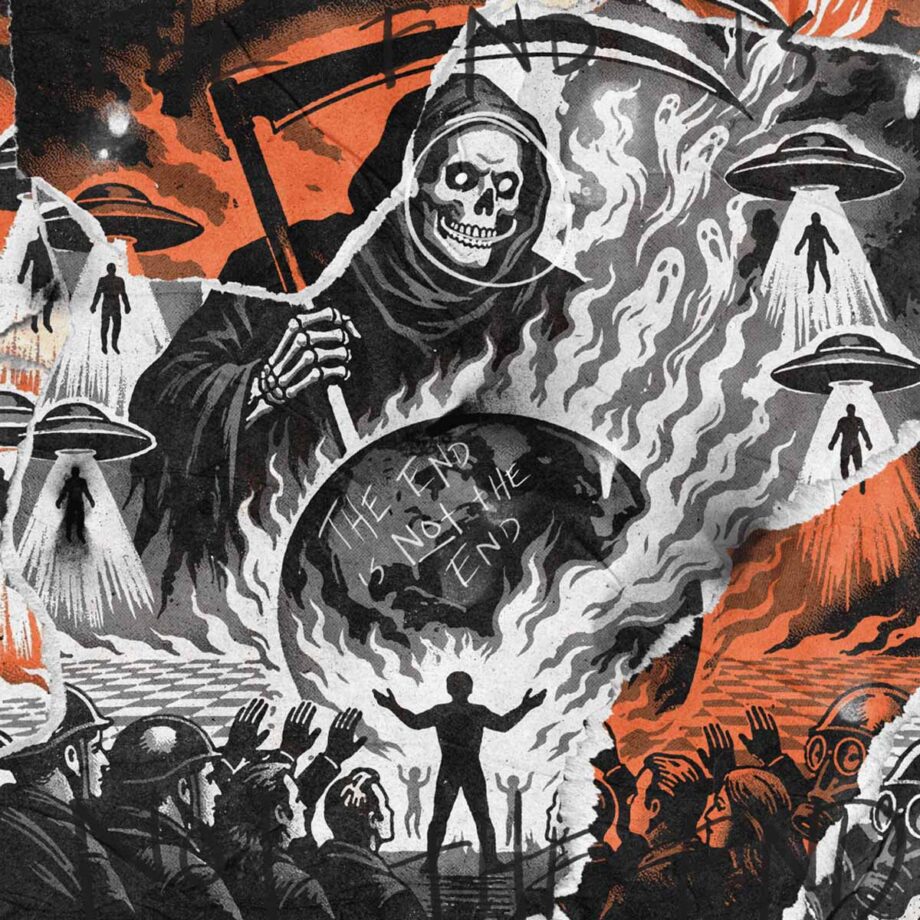
Atreyu’s The End Is Not the End arrives on 24 April 2026 as a late-career statement from a band that has spent more than two decades as a recognizable name in metalcore. The album follows the singles “Dead” and “Ego Death” and stands as the band’s long-awaited return to the studio, approached less as a routine continuation of the catalog and more as a deliberate reset. That framing matters because the record isn’t just new material — it’s a statement of what Atreyu currently wants to emphasize about its own identity.
The band avoided listening to outside new music while making the album, a choice that fits the broader theme of self-referential focus running through the record. The project was built around a simple question: what are the best parts of Atreyu? That approach makes the album feel like a career inventory as much as a standalone release. Parts of it were written between Tokyo and San Juan Island in Washington State, pointing to a more mobile and deliberately constructed creative process than a quick studio cycle. Taken together with its release timing and its “long-awaited” billing, the record marks a strategic moment for a veteran band balancing legacy, expectation, and reinvention.
The material consistently points to a record designed to foreground Atreyu’s heavier side, repeatedly described as the band’s heaviest yet and placed squarely in the alternative metal/metalcore lane. The heavier creative direction reinforces the sense that the album leans more toward impact and riff-forward songwriting than stylistic expansion for its own sake. The track listing itself suggests a tightly sequenced, full-length statement rather than a loose collection of singles, with 13 tracks and a runtime of about 45 minutes. That length, combined with the emphasis on distilling “the best parts of Atreyu,” indicates an album built around concision and familiarity, leaning on the group’s most established strengths rather than chasing a broader modern-metal palette.

A clear professional consensus is difficult to pin down at this stage, since most coverage so far consists of announcements, interviews, and early reactions rather than a wide body of in-depth reviews. What can be said with confidence is that the album has been positioned as an important band statement rather than a surprise pivot, with the conversation around it centered more on identity and heaviness than on radical experimentation. Any claim of a settled critical verdict would be premature until more extensive coverage takes shape.
Early interest has focused on the “heaviest album yet” angle, though much of that conversation remains anticipatory rather than evaluative, since it largely predates the release. The record quickly landed inside the core online communities that follow metalcore and adjacent post-hardcore releases, but there isn’t yet enough visible reaction to describe a settled verdict from listeners.
For modern metalcore audiences, the album’s relevance appears tied to durability rather than novelty. Atreyu is leaning on the parts of its sound that remain most recognizable — heaviness, melody, and directness — while presenting the record as a conscious restatement of its core identity. That makes The End Is Not the End less a document of reinvention than a test of how well a long-running metalcore act can still make familiar elements feel current in 2026.