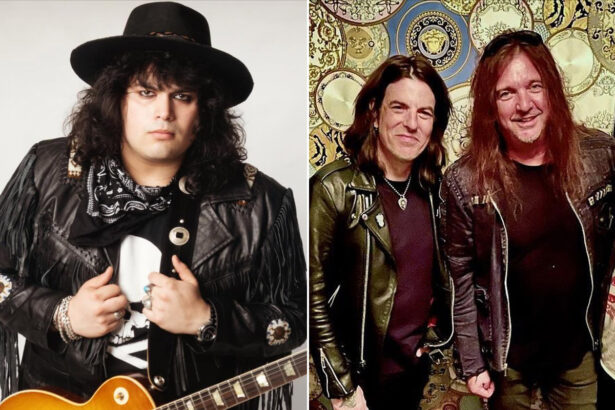


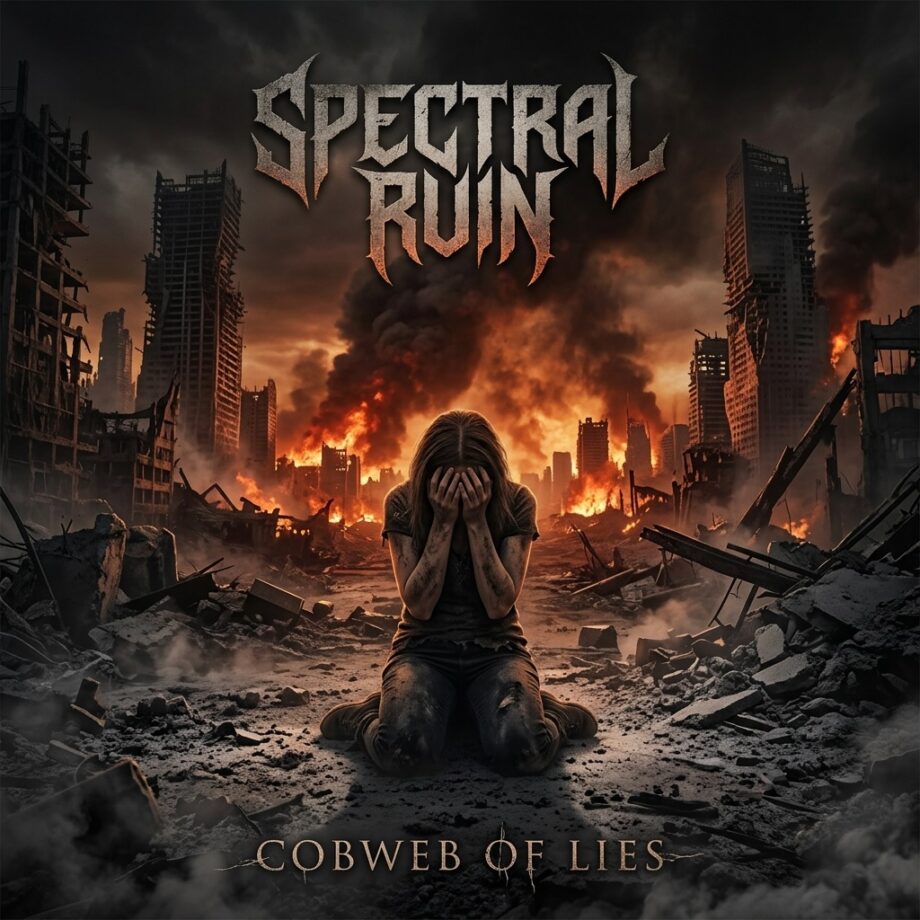
A one-man metal project from Brisbane, Australia has released its debut album more than three decades after its songs were first written.
Spectral Ruin is the work of Charles Toth, a 50-year-old father of three who works as a retail assistant at his local Coles supermarket. Long before the project appeared on streaming platforms, however, Toth was a 15-year-old high school student writing lyrics and imagining the metal band he might one day form.
“I used to play guitar, and I wrote all these songs in high school when I was 15,” Toth said. “I’m now 50.”

For 35 years, those songs remained unfinished. The lyrics survived, as did the name Spectral Ruin, but the music itself never made it beyond the ideas Toth had carried with him since his teenage years.
That changed following a health scare.
“After a health scare, I decided it was time to get them out into the world,” he said. “As I am physically unable to play them now, I decided to give AI a try.”

Toth discovered RockAgent through an advertisement on Facebook. He had not spent months comparing different AI music platforms or experimenting extensively with services such as Suno or Udio. He simply saw the advertisement, decided to test the platform and was immediately encouraged by what he heard.
“I saw an ad for RockAgent on Facebook and decided I’d give it a try,” Toth said. “I loved the result.”
The decision eventually led to a 15-track Spectral Ruin album built from lyrics written when Toth was still in high school.
The record includes tracks such as “Cobweb of Lies,” “Broken Faith,” “Shattered Souls,” “Blood Money,” “Metal Legion Rising,” “Judgement Day,” “Inferno’s Whisper” and “Seven.”
Toth describes the sound as “fast aggressive metalcore, with occasional slow melodic release, to stop the relentless punching in the face from the heavy songs.”
Despite the technology involved in producing the album, the foundation of Spectral Ruin remains deeply personal. These were not songs generated from nothing or lyrics assembled for an experiment. They were thoughts Toth had written decades earlier and held onto throughout his adult life.
Hearing one of those songs fully produced for the first time was an emotional experience.
“It felt cathartic to hear songs I wrote decades ago put to music, and someone singing them,” he said. “I couldn’t hold a note if you gave it to me in a bucket.”
The Spectral Ruin name also dates back to Toth’s high school years. It was not created as part of a modern marketing strategy or invented specifically for the album release.
“It was always the name I wanted if I ever made a band in high school,” he said.
Getting the vocals right meant rewriting the original songs
Although RockAgent gave Toth the means to finally hear his material brought to life, the process was not as simple as submitting lyrics and accepting the first finished version.
Toth said it took several attempts to understand how to describe the sound and vocal arrangements he had imagined for more than 30 years.
“The most surprising thing was how close it got to what I envisioned when I was inputting the prompts on how I wanted it to sound,” he said. “It took a couple of false starts before I figured out how to get the various vocal lines like I wanted.”
One of the biggest creative decisions involved the voice of Spectral Ruin.
Toth initially experimented with male vocals, but the results did not match the sound he had been carrying in his head since writing the songs. Female vocals brought the material much closer to his original vision.
That decision also created a new challenge. Some of the lyrics had been written specifically from a male perspective, meaning Toth had to revisit and alter material that had remained unchanged for decades.
“I also tried it with male vocals, and it didn’t feel right,” he said. “So I went with female vocals, and it was closer to how I wanted it.”
“That did mean I had to rewrite some of the lyrics, especially on ‘Seven,’ from a male to a female point of view.”
Rather than treating the technology as a one-click replacement for musicianship, Toth used it as a production tool, repeatedly adjusting the prompts, vocal direction and lyrics until the songs resembled what he had imagined as a teenager.
Seeing Spectral Ruin on Spotify was “a total head rush”
After decades of carrying the songs privately, seeing Spectral Ruin appear publicly on Spotify made the project feel real in a new way.
“A total head rush,” Toth said of the moment the album went live. “It felt like my music was finally on the internet for the world to listen to.”
Still, he is not rushing to promote it to everyone he knows.
Toth said he plans to begin by sharing the album with a small group of coworkers. He specifically wants feedback from people who are not related to him and who may be more willing to give an honest reaction.
“I haven’t shared it yet,” he said. “I’m going to share it with a select few at first on Monday at work.”
“I’m going to give it to people who aren’t related and ask for realistic feedback.”
For now, Spectral Ruin is primarily a personal project rather than the beginning of an attempt to build a full-time music career.
“Hobby for the most part,” Toth said. “I mainly just wanted all my thoughts out into the world.”
That does not necessarily mean the project will end with one album. Toth says he still has more ideas and songs in his head, although any future release will depend partly on how people respond to the debut.
“I may release some more, as I have other thoughts and songs bouncing around in my noodle,” he said. “But we’ll see how it goes with this initial release.”
“AI may be the way for them to get their thoughts, hopes and dreams out”
AI-assisted music remains a divisive subject, particularly among listeners and musicians who question whether music created with generative tools can feel authentic, emotional or personal.
Toth said he understands that skepticism. However, he views the technology through the perspective of someone who is no longer physically able to perform the music he wrote.
“I understand the scepticism, but I looked at it from a weird point of view,” he said.
“If someone is physically or verbally unable to play or sing, then AI may be the way for them to get their thoughts, hopes and dreams out into the world.”
For Toth, the album is not about replacing a band he already had or avoiding the work of learning an instrument. It allowed him to complete songs that had been waiting since he was 15, at a time when performing them himself was no longer physically possible.
The result is an album filled with material written in one period of his life and finally completed in another.
Asked to summarize what the process gave him, Toth returned to the two ideas at the heart of the record: catharsis and closure.
“Cathartic release after my health scare,” he said, “and some closure.”