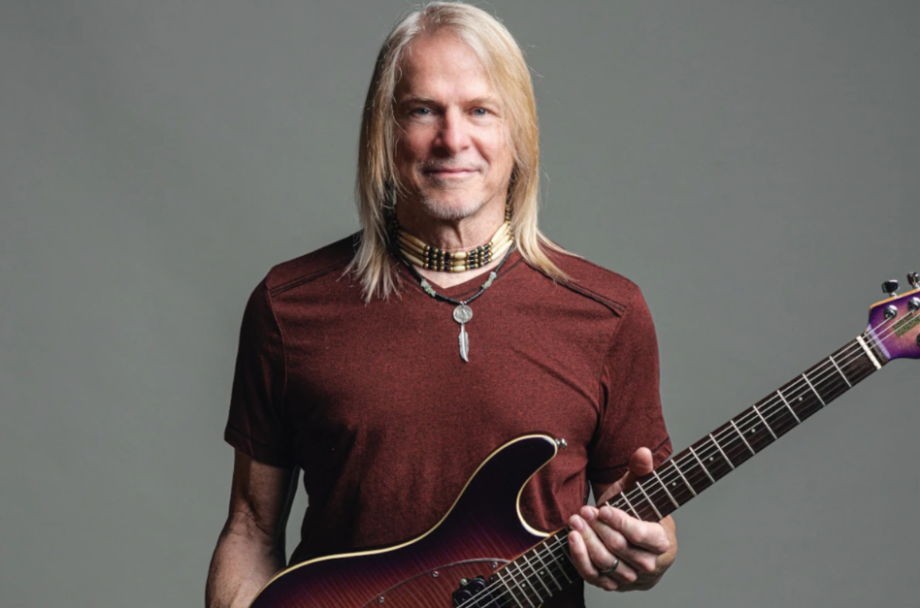
Steve Morse recently offered high praise for guitarist John Petrucci, calling him the pinnacle of musical achievement. In an interview with Jorge Botas, Morse discussed Petrucci’s remarkable steadiness and constant growth as a musician, noting how uncommon it is to sustain such an elevated level of performance over many years.
“Yeah, [John] Petrucci, I don’t see how you can get better than him,” Morse remarked. “I don’t think it’s possible. He’s gotten to the point, playing-wise, and kept it up, and he keeps improving. Actually, he’s, to me, the top of the heap, not that there’s a contest. But, I mean, he’s at the point now where I just can’t figure out how he can do that so consistently.”
He went on to recall a recent show he attended, where Petrucci’s musical sensitivity and technical accuracy stood out. “And he stayed so incredibly sharp and musical,” Morse continued. “I saw him with Dave LaRue and Mike Portnoy doing his trio from his solo record just recently. It was awesome, really. This guy’s something special.”

Morse added that he frequently references Petrucci in his teaching sessions as an example of exceptional discipline and technique. He highlights Petrucci’s focus on steady practice and meticulous attention to detail.
“He practices, and he is aware of details. He takes care of details. I love to bring him up when I do teaching clinics. You can learn all kinds of different things, but do you have what it takes to consistently stay at this level and keep getting better? I can point to one guy who I know, and who can do that. That’s John Petrucci. This guy puts in the time and the effort, and he’s thinking all the time about the best way to do this, the best way to finger that, the best way to technically accomplish this part.”
Morse’s admiration reflects Petrucci’s decades of rigorous practice and refinement. Understanding why Petrucci stands apart requires looking at the essential techniques and work habits that have shaped his role as Dream Theater’s lead guitarist.

Petrucci’s proficiency is rooted in several core techniques that define his playing. Instructional materials note his exceptional command of alternate picking, which underpins his speed and accuracy. He also uses sweep picking with precision, incorporates string skipping for intricate melodic movements, and makes extensive use of arpeggios and scales. These tools enable the clarity and reliability that Morse praises.
Petrucci’s technical foundation began early on. Masterclass sources describe how he started guitar at age 12 and often practiced up to six hours daily, frequently alongside his friend John Myung. This intense early dedication laid the groundwork for his future skill. His lifelong commitment to improvement mirrors Morse’s comments about Petrucci’s ability to remain consistently elite.
What truly sets Petrucci apart from other technically gifted players is his belief that technique should always serve the music. His teaching materials show that he emphasizes this idea regularly. He advises starting with simple three- and four-note arpeggios before progressing to more demanding patterns, turning exercises into melodies to avoid mechanical playing.
His focus on tone, phrasing, and expressive elements like vibrato ensures that his virtuosity remains musical rather than purely technical. Petrucci’s blend of complexity, melody, and emotion has made him a defining figure in progressive metal. His dedication to both flawless execution and expressive playing is exactly what Morse highlights when praising his rare ability to maintain excellence while continuing to evolve.