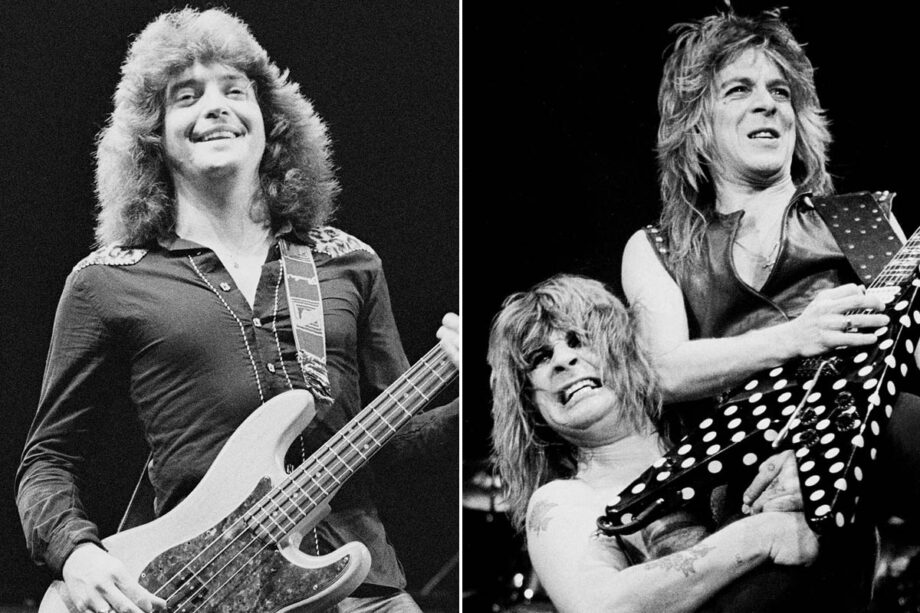
Bassist Bob Daisley has challenged the mainstream historical narrative surrounding Randy Rhoads’ tenure with Ozzy Osbourne. He claims the alleged family bond between them was a manufactured myth and reveals that Rhoads was deeply unhappy and planning to leave the music industry.
In a candid interview, Daisley disputed the romanticized version of the Ozzy-Randy relationship that has dominated rock history. “They built it up to make it sound like the Ozzy and Randy thing. But it was not like that, I can tell you right now,” Daisley explained. “We all bonded in our own way. Randy and I, musically, got on very well together. We used to sit on chairs opposite each other, just coming up with ideas and working on music.”
Daisley emphasized that the band functioned as a cohesive unit rather than a duo centered around Ozzy and Rhoads. “We’d all sort of have meals together. We’d go out together, we’d socialize together. It was a nice situation, but there wasn’t any particular bonding of one or two — of anyone. It was not a Randy-and-Ozzy thing.”

Most significantly, Daisley revealed that Rhoads was deeply dissatisfied with his situation by the end of his time with Osbourne. “Randy was not happy towards the end. I wasn’t there, but I know because Don Airey and Tommy Aldridge told me what was going on. Ozzy and Randy were not close anymore, and Randy wanted out,” Daisley stated.
According to Daisley, Rhoads had ambitious plans beyond rock music. “He wanted to pursue his master’s degree and go to Europe to study. The only reason he was gonna do the Black Sabbath stuff — he didn’t like Sabbath; he was not a fan — but he agreed to do it to get out of his contract so he could go free.”
These revelations take on a poignant significance when viewed against the backdrop of what would happen just months later. Randy Rhoads’ life was cut tragically short on March 19, 1982, when he was killed in a fiery plane crash in Leesburg, Florida. He was touring with Ozzy Osbourne at the time. The guitarist was only 25 years old. The crash occurred during a reckless “joyride” attempt where the plane made a low pass to buzz the tour bus. It ultimately clipped the vehicle, hit a tree, and crashed into a nearby structure. Two others—Rachel Youngblood and pilot Andrew Aycock—also perished in the accident, according to Ultimate Classic Rock.

Despite his short time in the spotlight, Rhoads had already established himself as a transformative force in rock music. Rhoads served as Ozzy Osbourne’s guitarist and co-songwriter on the first two solo albums: Blizzard of Ozz (1980) and Diary of a Madman (1981), as documented by Wikipedia. These albums were instrumental in defining Ozzy’s early solo sound and establishing him as a major force in heavy metal during the 1980s. Rhoads’ creative contributions extended beyond his technical prowess. He was a major creative force in shaping the direction of Osbourne’s music during this critical period.
The loss of Randy Rhoads represented an immeasurable blow to the metal community. The music world lost one of the most explosive and influential players to ever pick up a guitar when Rhoads died in that tragic joyride on March 19th, 1982, according to Live for Live Music. Despite his brief career spanning just a few years, Rhoads is widely regarded as a pivotal figure in metal music and a key architect of the early-1980s metal guitar style. His influence continues to resonate through generations of guitarists who have studied his innovative techniques and creative approach to the instrument.
Daisley’s recent statements add a complex layer to Rhoads’ legacy. They suggest that the guitarist’s final months were marked by frustration and a desire to pursue a different path—a path he would never get to explore.