


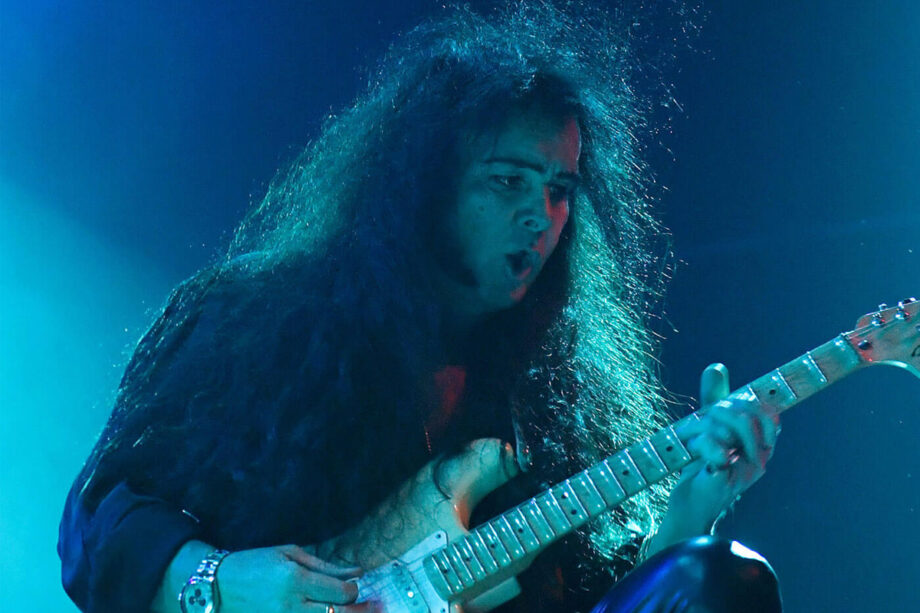
Yngwie Malmsteen explained how his decades of classical training have become so deeply rooted in his musical identity that he deliberately avoids listening to other artists while creating, speaking on Guitar Interactive Magazine.
The guitarist was asked whether modern composers or film composers influence his work now, or if he draws mainly from classical composers of centuries past.
Question: “Bringing up classical composers, of course, well documented that you’re very influenced by classical music. But I was wondering if there’s any like modern composers, film composers or just composers in general that are really influencing you now? Or is it more still the older guys from centuries ago?”

“Good question, good question. And here’s the thing. I’m not influenced by anything right now,” Malmsteen said. “I deliberately, I deliberately don’t allow myself to be influenced by anything.”
He explained that his 56 years of guitar playing, combined with his deep immersion in classical works, have given him a foundation that eliminates the need for external sources of inspiration.
“But I play guitar for 56 years or something. Absurd amount of time, yeah. And during the first, I don’t know, 20 years maybe, 30, 50, I can’t remember. I was so immersed in Vivaldi Concerto by Vivaldi, the flute concertos, I was so immersed in this that if you ask me to improvise something now, it will sound like it’s a classical written piece almost because it’s, that’s what’s inside me. It’s already there.”

Malmsteen outlined his approach to composition, which relies on avoiding external input entirely.
“And it’s so, how should I call it? It’s so settled in that I don’t really have influences. When I write, I don’t want to hear anything. I don’t listen to anything at all, whatsoever, nothing. And I don’t deliberately say, I’m gonna write this now or I’m gonna write that. I have and I can, but that’s to me, that’s not optimal, you know.”
He added that this method allows him to tap into what emerges naturally from his internalized musical knowledge.
“And I allow whatever the hell it is that I’m channeling or comes out of me from all these eons of, you know, compressing these tonalities, what it comes out as. Because I don’t want to know. Because I don’t want to, that’s why I say I always want to keep it as spontaneous as possible. But I want it perfect. It’s really stupid almost, you know. But that’s why I try to.”
Malmsteen made these comments during his conversation with Guitar Interactive Magazine. His remarks reflect his philosophy on how foundational classical training can shape an artist’s creative output for decades.
Malmsteen’s approach to composition mirrors the classical influences that defined his early years. As a young musician, he became absorbed in the works of Bach, Vivaldi, Tchaikovsky, and Paganini, whose styles would shape his entire musical identity. His guitar playing draws 99.9 percent from classical violin, particularly from Paganini, Vivaldi, and Tchaikovsky, while his songwriting follows Bach’s structural approach and his use of counterpoint and harmonic minor tonalities.
When Malmsteen released his debut album in 1984, it marked a turning point in rock music. The record introduced sounds unlike anything heard before and sparked a movement of guitarists who dedicated themselves to neoclassical guitar. His influence extended across generations of musicians who sought to blend classical technique with modern rock performance.
This philosophy of avoiding external input during composition has allowed Malmsteen to develop what he describes as spontaneous yet perfect output. Because he has played guitar for so many decades, he developed the ability to write music on demand when asked. For his album “Hell Or High Water,” released on November 13, 2026, Malmsteen spent eight months writing and carefully selecting the strongest tracks from 80 or 90 finished songs. He also released a live album called “Tokyo Live” in April 2025 as part of his 40th-anniversary world tour, with the concert recorded at the Zepp DiverCity, Tokyo on May 11, 2024.