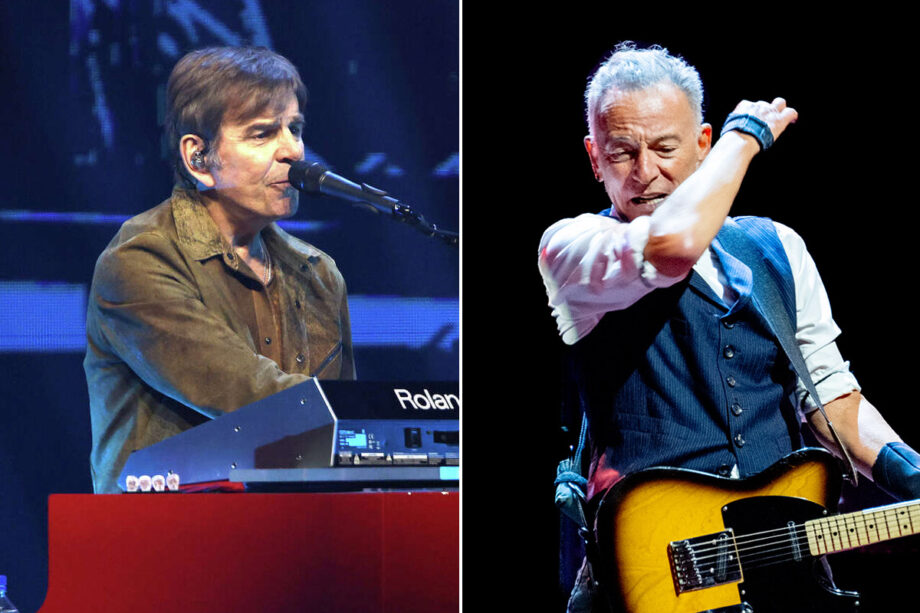
Journey’s keyboardist Jonathan Cain has launched a pointed critique of Bruce Springsteen’s political outspokenness. He called the legendary rocker an “annoying, bitter old man” who should focus on his music rather than his political views. In a recent interview, Cain expressed frustration with celebrities who use their platforms for political commentary. He argued that artists should instead work to unify audiences across party lines.
“Guys like Bruce Springsteen should shut up. Honestly, shut up, Bruce,” Cain said bluntly. “I try to keep politics out of my music. Now I’m releasing this patriotic song ‘The Winds Of Freedom: A Salute To America’ in celebration of America’s 250th anniversary because I’m a diehard patriot. Like Kid Rock, who’s my friend — we’re a couple of patriots and we love our flag and we love our nation.”
Cain is a self-described conservative and Christian artist. He took particular issue with Springsteen’s 1982 classic “Born in the USA,” claiming the song itself represents a criticism of America rather than a celebration. “You were born in the USA, weren’t you, dude? So act like it. But even that song, if you look at the lyrics, it’s a kind of a diss to our country,” Cain stated.

The Journey legend emphasized his belief that artists have a responsibility to bring people together rather than divide them along political lines. He pointed to Paul McCartney’s “Hey, Jude” as an example of music that transcends partisan boundaries. Journey’s “Don’t Stop Believin'” similarly unites audiences regardless of their political affiliations. “I think our job as artists is unifying people. I mean, Paul McCartney said, ‘Hey, when I sing Hey, Jude, Democrats and Republicans all sing together.’ And I feel the same way with Journey. We have our respective parties out there in the audience, and they’re singing ‘Don’t Stop Believin’,” he explained.
Cain’s comments reflect a broader tension in the entertainment industry over the role celebrities should play in political discourse. The keyboardist acknowledged his own political evolution. He was once a Democrat but shifted his views over time. “We’re blessed to live where we live. And I’m obviously a conservative. I used to be a Democrat back in the old days, but I couldn’t go there anymore. I thought Barack Obama maybe, but then I saw where he was going and I’m, like, ‘Okay, we can’t have this anymore.’ So I’m a diehard conservative,” he said.
Cain’s interpretation of Springsteen’s iconic anthem stands in stark contrast to the artist’s own stated intentions. Springsteen has explicitly identified “Born in the USA” as a protest song addressing the Vietnam War and the systemic neglect of American veterans returning home. The song emerged during a period when Springsteen was deeply concerned with issues of deindustrialization and economic inequality affecting working-class Americans. Rather than a blanket criticism of the nation itself, the track represents Springsteen’s attempt to highlight specific social and political failures that needed addressing.

Springsteen’s political engagement extends well beyond his songwriting. The New Jersey native has been vocal in his criticism of political leadership he views as harmful to the country. He famously called former President Donald Trump “treasonous” and a “moron.” His activism reflects a fundamentally different philosophy from Cain’s approach. He sees artistic expression as inherently political and believes that musicians have both the right and responsibility to speak out on matters of national importance.
The contrast between Cain and Springsteen illustrates two competing visions of artistic responsibility in contemporary America. Cain’s recent release of “The Winds of Freedom: A Salute to America” represents his preferred approach. It was timed to coincide with the nation’s 250th anniversary. This patriotic expression celebrates American values, freedom, and founding principles without direct political critique. It stands as his artistic counterpoint to what he views as Springsteen’s more confrontational style of political commentary through music.
Cain’s position reflects his identity as both a Christian artist and a conservative voice in rock music. He feels this combination is often unfairly scrutinized. “Now people say, ‘Well, you’re a Christian and you’re a conservative,’ and I’m, like, ‘So what?’ I don’t preach it on stage. I don’t spend 10 minutes talking about it. That’s who I am. And that’s okay. Again, I just don’t think it’s cool to have celebrities going there. It’s a bad look,” he concluded. He drew a distinction between personal conviction and public advocacy that he believes should guide artists in the modern era.