

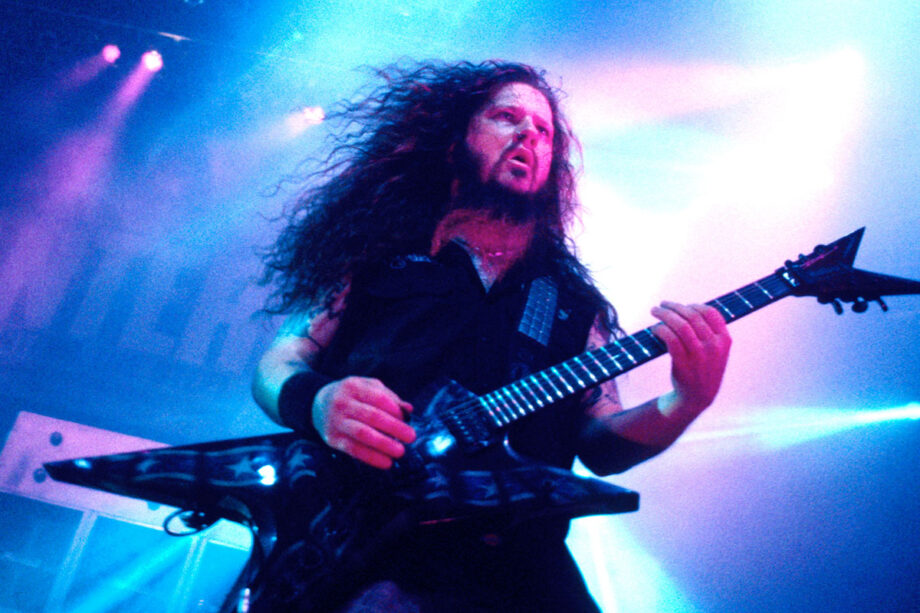
James Niggemeyer, the former Columbus, Ohio police officer widely credited for saving lives in 2004 when he entered the Alrosa Villa nightclub without backup and killed a gunman responsible for the deaths of four people, including Pantera/Damageplan guitarist “Dimebag” Darrell Abbott, recently opened up about the incident that ended his career and how his life changed in its aftermath.
On December 8, 2004, 25-year-old former Marine Nathan Gale of Marysville, Ohio, stormed the stage during Damageplan’s set and opened fire, killing Abbott, Damageplan security chief Jeffrey “Mayhem” Thompson, Alrosa Villa employee Erin Halk, and fan Nathan Bray. Reports at the time linked Gale’s actions to resentment over Pantera’s breakup, which he reportedly blamed on Abbott. Abbott, a founding guitarist of Pantera, had formed Damageplan with his brother Vinnie Paul after the influential metal band split up and was performing with the new group when he was killed.
Speaking on the Today’s Boondoggle Podcast, Niggemeyer recalled the night of the shooting, describing how he happened to be the first officer out of the substation when the active shooter call came through.

“When that call went out as a active shooter at the Alrosa Villa, I had happened to already have left the substation. That call went out about a little before 10:15 p.m. I worked 10 [p.m.] to 6 [a.m.], so we always have roll call at 10:00 o’clock, and then we go out to pack up our cruisers and head out,” he said. “Well, my district in that precinct was the farthest from the substation, so I usually tried to get going early ’cause I had the longest drive. So I was the first one out of the substation that day, when that call went out. But I carried a Remington 870 shotgun across my cruiser here. I was one of only two cruisers that carried it because my district was more rural, so we had deer-versus-car accidents — you had to put deer down and things — where the districts that were more in the city didn’t need them.”
Niggemeyer explained why he chose to use the shotgun instead of his sidearm when he confronted the gunman. “Well, the Remington 870 was the same shotgun that I hunted with since I was 12 years old. I knew that gun inside and out. So a lot of people ask me, ‘Why’d you use a shotgun instead of your pistol?’ Well, one, I’m more familiar with the shotgun, and two, I’m better shot with the shotgun. So that’s a question I get asked a lot.”
He described arriving at the club alone and being directed by fans to the location of the shooter, who was holding a hostage. “When I got [to Alrosa Villa] and was the only officer there, there were fans telling me where to go. I’d never been in the Alrosa in my life, so I wasn’t familiar with the layout. But when I entered the back door, where they had told me to go, and I saw the hostage in there, or the suspect in there holding a hostage. We didn’t know he was holding a hostage. That had not come out on the radio. And he still had the gun and was waving it around and things like that.”

Niggemeyer credited his lifetime of experience for helping him act decisively in the moment. “So I went ahead and snuck in at that point. But between hunting my whole life and military and police training, it was just a culmination of everything I had been through in my life. And you hear the words ‘tunnel vision’, but it was true — I had true tunnel vision. Literally, everything was black except for the suspect and the hostage. It was a true tunnel vision. I literally didn’t hear or see anything else. I can’t even tell you what people were screaming. So, I think it was just everything together. Training — in the police department, we had just done active shooter training a couple of months prior. Of course, the active shooter training we had did, we had did it with groups of four, not on our own.”
He explained his decision not to wait for backup. “But I don’t know if the situation would’ve been different had he not been holding a hostage. But because he was holding a hostage and he had the hostage in a headlock, I just felt like I couldn’t sit and wait on backup. So, yeah, it was just a lifetime culmination. And I knew that weapon really well and what it was capable of doing.”
The aftermath of the shooting took a severe toll on Niggemeyer’s mental and physical health. “I was hospitalized for panic attacks. That was the thing that got me the most, was the panic attacks, and then the constant nightmares. It really took me a long time that my brain just wouldn’t shut down. And doctors and everybody tried a lot of different things to try to get it… I’d just be here on a normal day, like talking to you, and I’d just go into a full-blown panic attack, and I couldn’t breathe. So, it affected me mentally, but that also affected me physically, to the point where the department retired me medically because of it.”
Ultimately, the incident ended his career, but Niggemeyer said he has no regrets. “So, yeah, it ended my career, something that I did, everybody tells me extremely well, ended up ending my career. But I don’t regret it for a minute. I’m glad I was able to stop him before a lot more people were hurt. But it certainly didn’t… It kind of set my life on a spiral. But that’s part of the job. You sign up for it. You just have to deal with it, I guess.”
Niggemeyer’s account shows that the tragedy at Alrosa Villa did not end when the shooting stopped. More than two decades later, he remains proud that his actions prevented further deaths, even though the decision he made that night ultimately came at a heavy personal cost.