

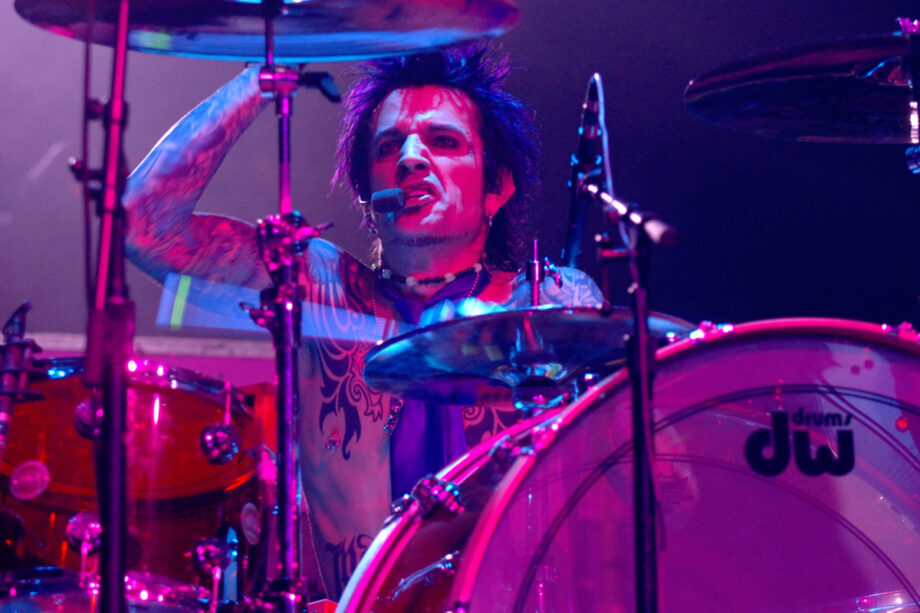
Mötley Crüe drummer Tommy Lee has revealed the profound creative and personal struggles that led him to temporarily leave the iconic band in 1999. Lee detailed how feeling creatively stifled within the band’s rigid sonic format pushed him to seek an outlet for his artistic expression.
“I actually did quit Mötley Crüe for a couple years,” Lee explained. “I was creatively dying slowly as just my personal, you know, musicianship and craft and stuff and I was getting. I just I needed an outlet.”
Lee described how the constraints of the Mötley Crüe format prevented him from exploring his full creative potential. “I wasn’t able to creatively do anything outside of the, you know, sort of the Mötley format,” he said. This emphasized the limitations he felt within the band’s established sound.

The drummer’s departure marked a turning point in his career. It coincided with significant personal turmoil. Lee revealed that a transformative moment during his 1998 jail sentence made him realize he needed to fundamentally change his life and creative direction.
“I was like, I gotta change something because obviously I’m here and this is, you know, I gotta switch it up because I got to get happy and get out of here,” Lee recalled. “It was linked to creativity. It’s such a big part of me. If you’re not happy creatively and you don’t feel like you’re able to constantly evolve and create and do that stuff, that’s dangerous.”
Lee’s solution to his creative suffocation came in the form of Methods of Mayhem. This project allowed him complete artistic freedom. Wikipedia notes that Methods of Mayhem was formed in 1999 as an American rap rock/metal band when Tommy Lee temporarily quit his position as Mötley Crüe’s drummer. This venture represented a radical departure from the heavy metal sound that defined his work with Mötley Crüe.

Lee described Methods of Mayhem as his “adult sandbox”—a space where anything goes creatively. “Like literally anything goes. No genres, no style, no doesn’t matter. We’re doing whatever what I want to do, you know, and just have fun with it,” he explained. The project blended rock, hip-hop, and dance elements. It showcased a side of Lee’s musicianship that had been suppressed within Mötley Crüe’s framework.
The creative frustration that drove Lee away from Mötley Crüe was rooted in the band’s resistance to experimentation. Music critics observed that Tommy Lee’s vision was to marry guitar riffs to sick beats, and he quit Mötley Crüe in order to pursue this fusion. The band’s established sound and expectations had become a creative prison for the ambitious drummer.
Lee’s departure wasn’t merely about musical differences. It was a necessary step for his mental health and personal survival. The combination of legal troubles, personal crises, and creative stagnation had pushed him to a breaking point. By stepping away from Mötley Crüe, Lee was able to reclaim his artistic agency and explore the full spectrum of his musical capabilities without the constraints of the band’s legacy and expectations.
Although Lee’s break from Mötley Crüe was initially framed as temporary, it became a pivotal moment in his career trajectory. Audacy reported that when Tommy Lee was taking a break from Mötley Crüe in 1999, he branched off into the rap-metal world with his Methods of Mayhem project. The project eventually stood on its own rather than being treated as a mere side project.
Lee’s experience underscores a broader truth about creative fulfillment and mental health. The inability to evolve artistically can be deeply damaging to one’s psychological well-being. His decision to prioritize his creative needs and personal recovery over his commitment to Mötley Crüe demonstrated the importance of artistic autonomy and self-care. This was true even at the cost of stepping away from one of rock’s most legendary bands.