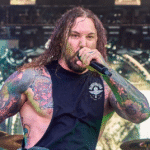



Jesse Hughes, vocalist of Eagles of Death Metal, recently discussed the origin of Queens of the Stone Age’s name and shared his view with Alternative Nation.
Hughes stated that the name carries historical meaning within gay community slang rather than being invented by the band. As he put it, “The thing about Queens of the Stone Age is that I feel like I probably understood what was going on a little bit better than everyone else, because Queens of the Stone Age is not a made up name,” Hughes said. “It’s an old gay community term, okay? And it means an uncool homosexual, a ‘queen of the stone age.’ Like, ‘Don’t invite him. He’s not even into Bowie. He likes Liberace. He’s a real queen of the stone age.’”
According to Hughes, Josh Homme intentionally adopted the label with complete awareness of its meaning. Hughes continued, “So when Josh heard that, he was like, ‘Yeah, old f*g, I’ll take it,’” before noting that the juxtaposition of the name with the group’s powerful sound created “an anomaly and an enigma that’s almost something that you would consider to be impossible on paper.”

Although Hughes offers one interpretation, the history behind the band name extends further into Josh Homme’s earlier career. The moniker “Queens of the Stone Age” originated during Homme’s time in Kyuss when producer Chris Goss jokingly referred to the group as “the Queens of the Stone Age” during a 1992 recording session.
After Kyuss disbanded in 1995, Homme launched a new project in 1996 initially called Gamma Ray, later forced to abandon that name due to legal objections from a German band. That situation prompted Homme to revive the earlier nickname for his new band.
Homme selected “Queens” rather than “Kings” in order to avoid a hyper-masculine association and instead present a name that suited both the heavier and more melodic aspects of the music. This philosophy contributed to the band’s distinctive aesthetic, which helped define its role in contemporary rock.

Throughout the group’s development, Homme remained the central creative force. The lineup evolved to include notable collaborators such as Nick Oliveri during early touring and Dave Grohl for the 2002 album Songs for the Deaf, reinforcing Homme’s influence on the ensemble’s stylistic direction.