

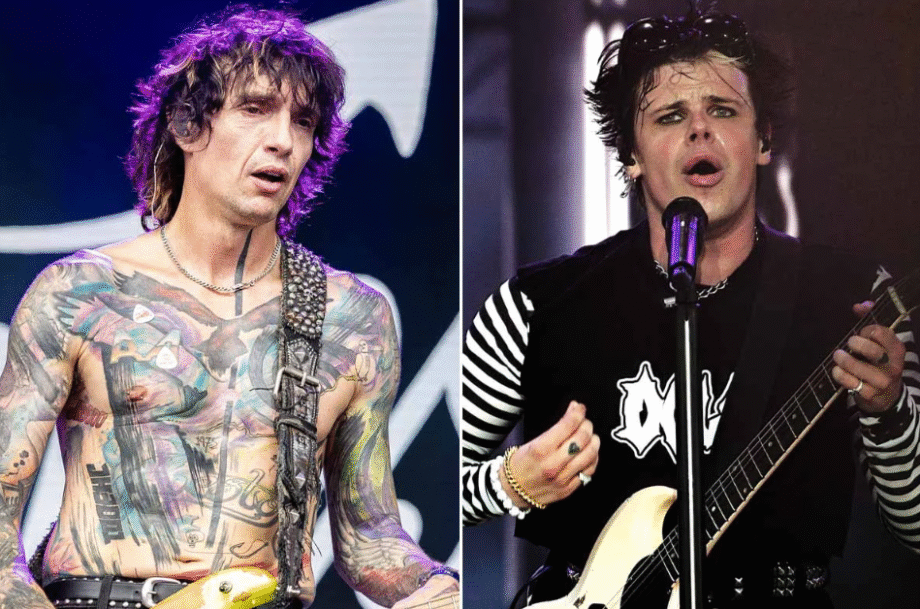
Justin Hawkins recently took aim at artist Yungblud for relying on real-time pitch correction during live shows. He shared his thoughts on Justin Hawkins Rides Again, where he discussed the larger issue of autotune within the music world.
Although many performers have experimented with the tool since its emergence, its presence in live settings continues to spark debates about authenticity. “When it first came out, everybody tried dabbled with it, and I think there’s a lot there’s a sort of temptation to use it,” Hawkins said. “You know, just to be competitive with the stuff that’s on the radio which is all tuned to have been an inch of his life.”
Hawkins specifically singled out Yungblud, referencing observations from others who have tracked the singer’s use of live pitch correction.

“And then you get artists like Yungblud who have been proven by people like wings of Pegasus to have been using uh real-time pitch correction live and that’s just that is really an embarrassment,” he stated. “Shouldn’t be happening.”
He went on to suggest that closed side-stage setups at festivals may indicate questionable practices, especially involving real-time autotune.
“If you’re not allowed side stage when you have an AAA pass at a festival because it’s a closed side stage, it’s usually a closed side stage because there’s something suspicious going on,” Hawkins explained. “Usually within that remit of usual usual stuff, I would say it’s probably because they’re running autotune in real time, which is a f*cking embarrassment.”

Hawkins wrapped up his remarks with a direct appeal to artists using such tools: “You shouldn’t be doing that. Yungblud, you shouldn’t be doing that. Just sing. If you can sing, sing. You don’t need that stuff.”
His comments add to a long-running conversation within the rock community about what qualifies as genuine performance and how technology should factor into modern music.
According to Louder Sound, Hawkins’ critique of Yungblud’s live approach stems from broader concerns about authenticity in rock, with the issue being spotlighted after Yungblud’s appearance at the MTV Video Music Awards. Hawkins felt the heavy use of production techniques conflicted with the ethos of classic rock, calling such performances “rock n’ roll seen through an Instagram filter.”
Architeg Prints reported that Hawkins defended his stance by emphasizing he wasn’t attacking Yungblud personally, but rather questioning the trajectory of rock as it becomes more dependent on technology. He stressed that his remarks targeted the performance, not the performer.
The backlash arrived swiftly. Ultimate Guitar noted that Yungblud and his fans criticized Hawkins’ comments as outdated gatekeeping, arguing that Yungblud is bringing fresh energy to the genre. They viewed Hawkins’ remarks as overly harsh and dismissive of evolving creative approaches. In response, Yungblud labeled his critics “bitter and jealous,” suggesting that some veteran artists struggle to accept new voices in rock.
Ultimately, the exchange highlights a generational divide within the genre: one faction insisting on traditional standards of live authenticity, the other welcoming technological experimentation as part of modern expression. As the debate continues, it raises larger questions about the future of rock and what audiences should expect from live music in an increasingly digital landscape.