

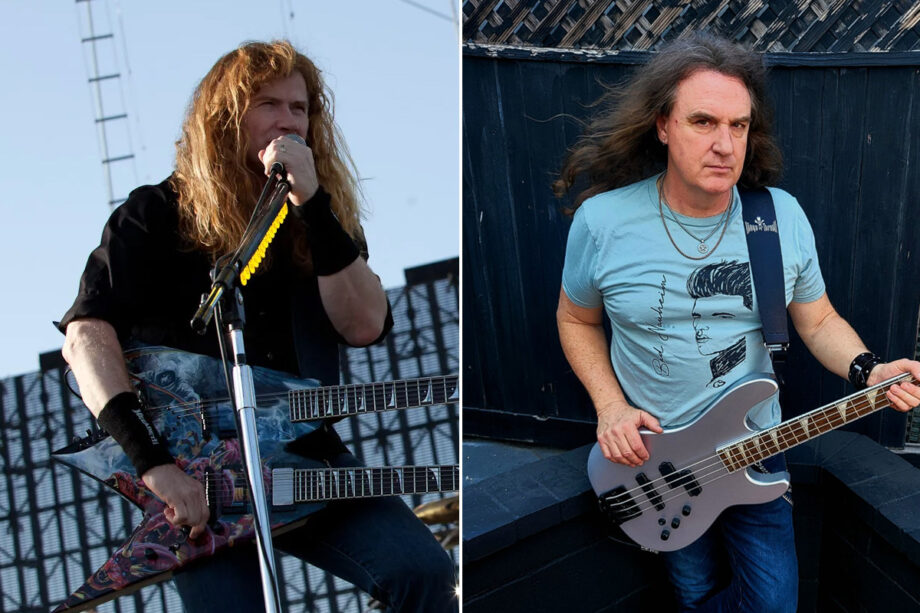
Megadeth frontman Dave Mustaine recently reopened the discussion regarding David Ellefson’s departure from the band, sharing his perspective on the 2021 scandal and revealing that Ellefson’s exit may have been inevitable regardless of the incident. Mustaine’s comments were featured in an excerpt from his book published by Rolling Stone.
Mustaine detailed how he first learned about the leaked videos and described the immediate impact the situation had on the band.
“I found out about the scandal the same way that everyone else found out: I heard about it online,” Mustaine said. “On May 10, 2021, sexually explicit videos of David Ellefson masturbating appeared on Twitter. The videos resulted from an online interaction with a nineteen-year-old Megadeth fan with whom Ellefson had engaged in some sort of relationship. When more details were revealed, the story quickly went viral. It was impossible to separate fact from fiction, truth from fantasy, as the Internet exploded in typically histrionic fashion. But this much was clear: that was definitely David Ellefson, Megadeth bass player, in the videos.”

He then reflected on their long and turbulent history, noting that their relationship had already been severely strained over the decades.
“I was reevaluating my nearly 40-year relationship with David and the turbulence it had so often caused in my life,” Mustaine continued. “As original members of Megadeth (David likes to say he was a ‘founding’ member. I don’t view it that way. I started Megadeth and invited him to join), we had been friends and creative partners; we had fought like enemies. We had played a lot of great music together. We were codependent junkies, feeding and fueling each other’s addictions. Ultimately, we had grown apart, trust shattered (at least for me) by David’s 2004 lawsuit after the band’s breakup. We fought in court. The outcome was not nearly what he hoped for — let’s leave it at that.”
Mustaine explained that even after Ellefson returned to Megadeth in 2010, the underlying tension and differences in their personal lives remained unresolved.

“To the surprise of the vast majority of the Megadeth universe, we patched things up in 2010 and David returned to the band, albeit as a salaried player and not a creative partner,” Mustaine added. “But things were never great between us; there was too much history, too much anger, too much behavior that I found distasteful. Part of the problem was that our initial friendship was based primarily on two things: music and drugs. David and I were never on equal footing when it came to Megadeth; it was my band and mostly my songs, and that was always a source of friction. When we both got sober, the distance increased, in part because we had lost the awful, unhealthy thing that had bonded us, but also because we approached sobriety and recovery from different places, with different points of view. I tried not only to be substance-free, but also to live a more honest and spiritual life. There are plenty of people in the fellowships who want to be better human beings and to provide support for their fellow travelers, people who are committed to genuine transformation. And there are others who mostly just talk the talk.”
He concluded by explaining that their relationship had already begun to deteriorate once again before the videos surfaced, making the split highly likely.
“I try to stay away from these folks. Sometimes unsuccessfully,” Mustaine said. “All of this is by way of saying that by the time those embarrassing videos turned up on the Internet, my relationship with David — and David’s relationship with Megadeth — had already begun to deteriorate. Again. Would David have remained a member of Megadeth if that video had not surfaced? Who’s to say? I’ve seen enough guys come and go with Megadeth, and I’ve experienced enough upheaval with David to know that the end was likely near. But, certainly, the scandal hastened the process.”
Mustaine’s comments come after a series of major breaks and reunions between the two musicians, whose professional relationship has shaped much of Megadeth’s history.
Ellefson played bass in Megadeth from 1983 until the band’s breakup in 2002. He was part of the group’s classic lineup and remained closely associated with Mustaine through Megadeth’s most successful period.
Their relationship later entered a legal dispute. Ellefson sued Mustaine for $18.5 million in 2004 over alleged unpaid merchandise and publishing royalties. The case was dismissed in 2005 before the dispute was eventually settled out of court.
Ellefson returned to Megadeth in 2010 for the band’s touring plans surrounding the 20th anniversary of Rust in Peace. He replaced James LoMenzo and remained with the band for more than a decade before his departure in 2021.
The split became official in May 2021, after explicit videos and messages involving Ellefson were posted online. Megadeth subsequently brought back James LoMenzo, who returned as the band’s bassist for touring before later becoming a permanent member.
After leaving Megadeth, Ellefson continued working on several projects, including The Lucid, Kings of Thrash and Dieth. These projects marked the next stage of his career after his second and final Megadeth tenure.
This excerpt offers a deeper look into the internal dynamics of Megadeth leading up to the high-profile lineup change.