

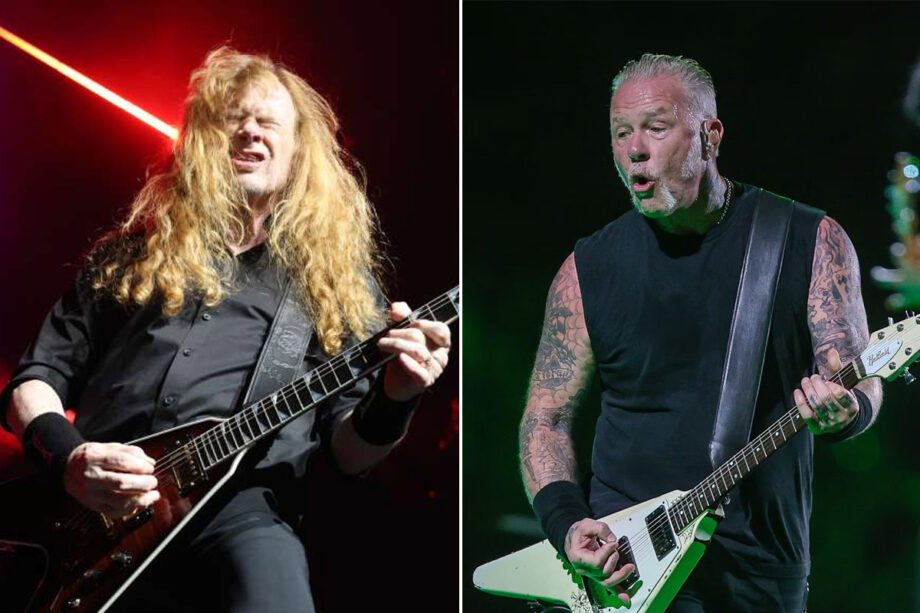
Megadeth frontman Dave Mustaine has opened up about his decision to record a cover of Metallica’s classic “Ride The Lightning” for his band’s final studio album. He candidly revealed that James Hetfield’s powerful vocal performance on the original track pushed his own singing abilities to their absolute limit. In discussing the ambitious undertaking, Mustaine reflected on the song’s significance and his approach to reimagining it for Megadeth’s farewell project.
Mustaine explained that the choice to include the track was deeply personal. It serves as a way to close the circle on his career and pay respects to his former bandmates. “We chose to do a version of ‘Ride The Lightning’, partly because I wrote with the band on that song. So it just seemed like the natural thing to do — close the circle, pay my respects to the band that I got my break in, and let James and Lars know how I really feel about stuff,” he stated. The decision carries particular weight given Mustaine’s history with Metallica, having served as the band’s lead guitarist from 1982 to 1983 before his departure.
Mustaine’s admiration for Hetfield’s musicianship runs deep. It extends beyond his vocal prowess to his guitar skills. He recounted a pivotal moment early in Metallica’s formation when Hetfield’s guitar abilities immediately impressed him. “We were playing one day. We had a guitar player. He says, ‘I want to be called Damien Phillips when I get up on stage.’ And I went, ‘Uh, beat it, buddy.’ So we ended up going to the venue, we’re playing and I look over and he’s got a feather earring in his ear. And I thought, ‘Oh, this is gonna be so bad.’ The next day I got to rehearsal, and he’d been fired, and James is playing guitar. And he’s not playing guitar like somebody in this room would. He’s playing guitar like me. And I thought, ‘No f*cking way. This guy is that good, and he doesn’t wanna be known for his guitar playing?'”

The cover version was released as a bonus track on Megadeth’s self-titled final album, which launched on January 23, 2026. It represents far more than a simple tribute. Mustaine and his current lineup made deliberate musical choices to distinguish their interpretation while honoring the original composition. The band increased the tempo slightly and restructured the solo section to incorporate their own flair. Mustaine split the guitar work among current Megadeth guitarist Teemu Mäntysaari and himself, while drummer Dirk Verbeuren was given creative freedom on the final drum fills.
Mustaine’s version is based on the original composition he co-wrote with Hetfield, Lars Ulrich, and Cliff Burton during the early 1980s. The band later rewrote portions of the track. This distinction is significant, as Mustaine has long maintained that the song represents partly his own work rather than being purely a Metallica composition. The cover features one of Mustaine’s signature guitar techniques: the spider chord. He invented this technique and has used it throughout his songwriting career, including in Megadeth’s “Wake Up Dead” and several other compositions.
The vocal challenge presented by Hetfield’s original performance proved substantial for Mustaine. He acknowledged that attempting to sing the song pushed his vocal abilities to their limits. This represents a candid admission from an artist known for his distinctive growl and commanding stage presence. Rather than attempting to replicate Hetfield’s approach, Mustaine adapted the vocal delivery to suit his own style. He recognized that his singing differs fundamentally from his former bandmate’s more forceful delivery. This artistic choice allowed the cover to stand as its own interpretation while maintaining respect for the original.

The recording process itself became a collaborative effort that reflected Megadeth’s current lineup and Mustaine’s vision for the band’s farewell. In the solo section, Mustaine communicated his intentions clearly to his musicians. He asked Mäntysaari to take the first third of the solo, handled the middle section himself, and allowed Mäntysaari to complete the final part. This division of labor ensured the version would have distinctive Megadeth characteristics without sounding like an attempt to copy Kirk Hammett’s original solo work. Mustaine noted that he couldn’t locate recordings of his original performance on the track. The reconstruction process became an exercise in creative interpretation rather than strict replication.
The decision to include “Ride The Lightning” on Megadeth’s final album carries symbolic weight as the band prepares for its farewell tour in 2026. The cover serves as both a musical statement and an emotional bookend to Mustaine’s legendary career. It acknowledges the formative years he spent with Metallica while celebrating the decades he spent building Megadeth into one of thrash metal’s most influential acts. The track has received positive reception from fans and critics alike, with many viewing it as a poignant full-circle moment for an artist who helped define the genre’s sound and trajectory.