

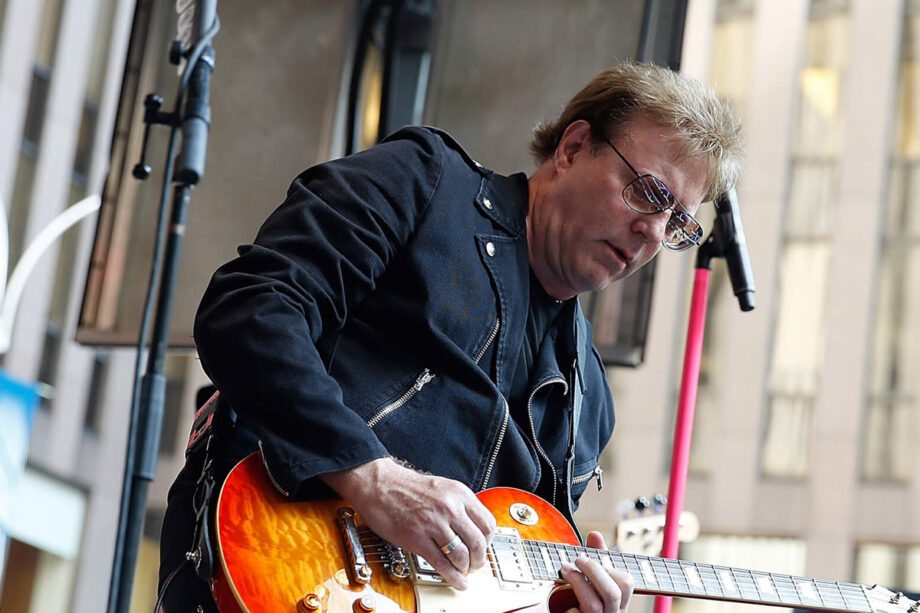
Twisted Sister guitarist Jay Jay French addressed the band’s absence from the Rock And Roll Hall Of Fame during an appearance on The Mistress Carrie Podcast, arguing that the institution has failed to give the band the respect it deserves despite massive commercial success.
“The thing that’s ironic about that statement is that our record sales are up there. So if you’re using record sales internationally, we’re at the 30-million mark, and I’ve got, like, 37 gold and platinum albums from around the world, and we’ve played in 40 countries as a headliner around the world,” French said.
“But you take a band like The Velvet Underground — there’s a perfect example of what you say. There’s a cliché about The Velvet Underground: ‘The Velvet Underground only sold 3,000 albums, but everybody who bought one started a band.’ And I love that. I love that cliché, ’cause we’re also big Velvet Underground fans. And so that’s exactly to your point. That’s exactly to your point. Now, The Velvet Underground is in the Rock And Roll Hall Of Fame, I believe. So is Lou Reed. And they are justifiably in it. There are some artists, I don’t believe, are justifiably in it, but that’s a political game, ’cause I think you know as well as I do there’s politics involved in every Hall Of Fame.”

“It’s music ‘business’, and I know the politics of the business. And so it almost doesn’t surprise me that we don’t get the respect we should get, ’cause we’re from Long Island, and Long Island doesn’t get a lot of respect. It really doesn’t. I mean, yes, Billy Joel’s from Long Island — I get that — but Long Island in general doesn’t get that much respect in the industry, even though we’re only a stone’s throw from Manhattan. We just don’t.”
“And that’s the irony, is that Twisted Sister was selling out these gigantic rooms in the New York area at the time the CBGBs was exploding. But those bands at CBGBs, which was Blondie, Television, the Ramones, those guys couldn’t work in any of the places we were playing ’cause they couldn’t sell tickets. We, however, were selling out 5,000-seaters all around New York and never playing New York City.”
“So when our manager suggested we should play New York, we said, ‘There’s no place big enough to hold us.’ Remember, this is 1979 — no record deal. And he said, ‘Why don’t we play the Palladium Theater, which holds 3,500 people?’ And I said, ‘No band without a deal has ever sold out the Palladium.’ And we did — twice. And that was a point we made to the music business, which is, ‘You guys don’t respect us, you don’t understand us, but our following is massive.’ And we had a massive following.”

French’s frustration is not a new theme for him, and it fits into a longer history of how Twisted Sister built its career outside the traditional industry pipeline. The band’s live reputation came first, and the record deals arrived much later.
French has repeatedly pointed to that period as proof of the band’s drawing power, noting that Twisted Sister was selling out 5,000-seat rooms across the New York area in 1979 while still unsigned, and that the group later sold out the 3,500-capacity Palladium Theater twice. Those shows became the band’s argument to an industry that had spent years passing on them.
The standards used by the Hall help explain why a band with that kind of commercial record can still be overlooked. An artist becomes eligible for induction 25 years after their first commercial release and must have demonstrated “musical excellence, impact, and influence.” Nominees are chosen by a nominating committee, and the final list of inductees is decided by a broader group of voters drawn from historians, industry figures and artists. The criteria reward influence and innovation as much as sales, which is precisely the gap French described.
That gap has fueled criticism of the Hall for years, and Twisted Sister’s frontman has been one of its loudest critics. Dee Snider called the people behind the Hall’s decisions “elitist mothereffers” in 2023. A year later, he wrote an open message urging the Hall to stop waiting until influential bands die before inducting them.
Twisted Sister’s commercial peak arrived with the 1984 album Stay Hungry, which produced the hit “We’re Not Gonna Take It” and turned the band into one of the most recognizable hard rock acts of the decade. Even so, Snider has been inconsistent about whether the band belongs in the Hall. He said in 2018 that Twisted Sister should not be inducted, explaining, “No, we don’t make that mark.”
Snider has also framed the question around sales rather than influence. He said in 2016, “Eligible by years, but I don’t think we have the record sales.”
French’s latest remarks keep that debate alive. Twisted Sister sold millions of records, headlined arenas and theaters around the world, and still sees itself as a band the industry never fully embraced — a tension the Hall of Fame’s own criteria do little to resolve.