

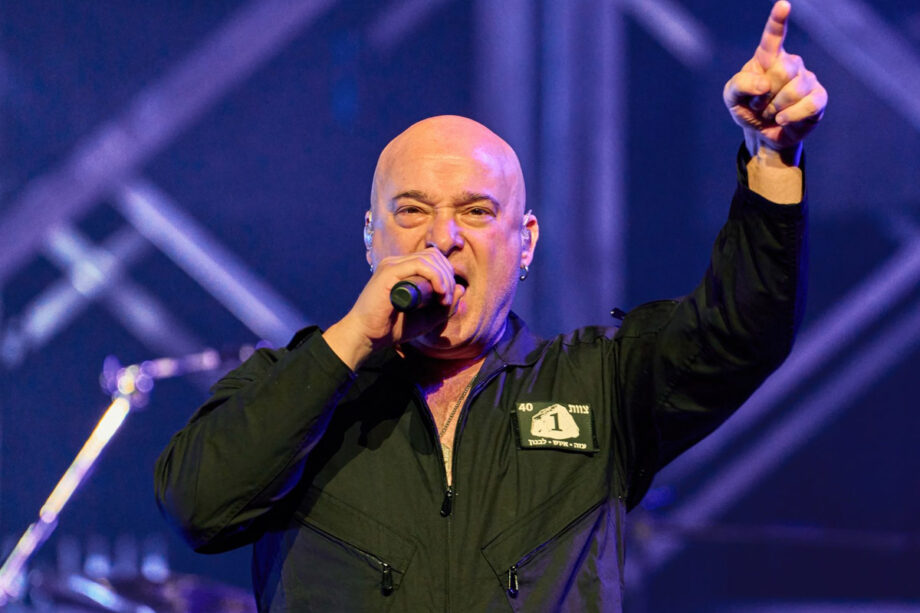
Disturbed frontman David Draiman talked about his Jewish background and explained why he is no longer afraid to express his opinions and stand up for what he believes in without fear of public backlash affecting his band during an appearance on The Brink podcast.
David Draiman: “Well, my mother’s side of the family, we’re a family of Holocaust survivors. My grandmother on my mother’s side was a survivor of Auschwitz, and my grandfather on my mother’s side was a survivor of Dachau. So, it’s meant a lot for all kinds of reasons, whether on my mother’s side, my father’s side, for a very long time.”
“So, it’s been a part of who I am, and since I am, I would think, a significant part of the band, that it’s a part of who we are, truth be told, whether we like it or not. And believe me, in today’s environment it would be a lot easier to not have the association. It’s a burden to carry that a lot of people don’t realize.”

“When I explained that to my guys in the band, I think they had a better understanding of it because on the outside, and unfortunately too many in the space, and this is gonna be something that probably many don’t like hearing and they’ve heard me say it before, and I really… I have the luxury at this point of my career and my life that to not really care if there’s backlash to me being truthful about something.”
“And the truth is that too many view the defense of our people as a business, and too many try to profit off of it, and too many go ahead and enjoy having their backs patted in echo chambers everywhere and it reverberates and it leads to higher speaking fees and you name it, and it’s just insanity. I am a part of it to an extent, just to the extent that I will do it for absolutely nothing. I never ask for anything. And for me, it’s a detriment. It’s other people in the space that have kind of taken advantage of it and made it part of their persona and made it part of like… If you are blessed with a platform, if you are blessed to influence and be an influencer, you’re given a gift.”
“Use it responsibly, use it honorably, use it without trying to self-enrich, without trying to take advantage of a situation that is dire. And I see a lot of people taking advantage, and they should be ashamed of themselves, with all due respect. I wish people were more centrally focused on the fight and on the defense of our people and less focused on themselves.”

Draiman’s comments continue a long-standing public discussion about his family history, Jewish identity and opposition to antisemitism.
Draiman has previously said that both of his maternal grandparents survived Nazi concentration camps. In that account, he said his grandfather was assigned to transport bodies to the crematorium at Bergen-Belsen, while his grandmother survived Auschwitz as a child.
Draiman has also described speaking about his family’s experience as an obligation, particularly as fewer Holocaust survivors remain alive to share their stories. The United States Holocaust Memorial Museum has documented his calls to confront antisemitism and preserve survivors’ testimony.
His connection to Judaism began early in life. Draiman was raised in an Orthodox Jewish environment, trained as a cantor and led High Holiday prayers during his early teens.
Draiman has previously spoken about encountering antisemitism in the rock world and about how his family’s history shaped his views on Israel and Jewish identity. He spent part of his childhood and teenage years in Israel.
Disturbed’s career has given Draiman a platform far beyond Jewish advocacy. The band broke through with its 2000 debut album, The Sickness, and reached a wider mainstream audience with its 2015 cover of Simon & Garfunkel’s “The Sound of Silence.”