

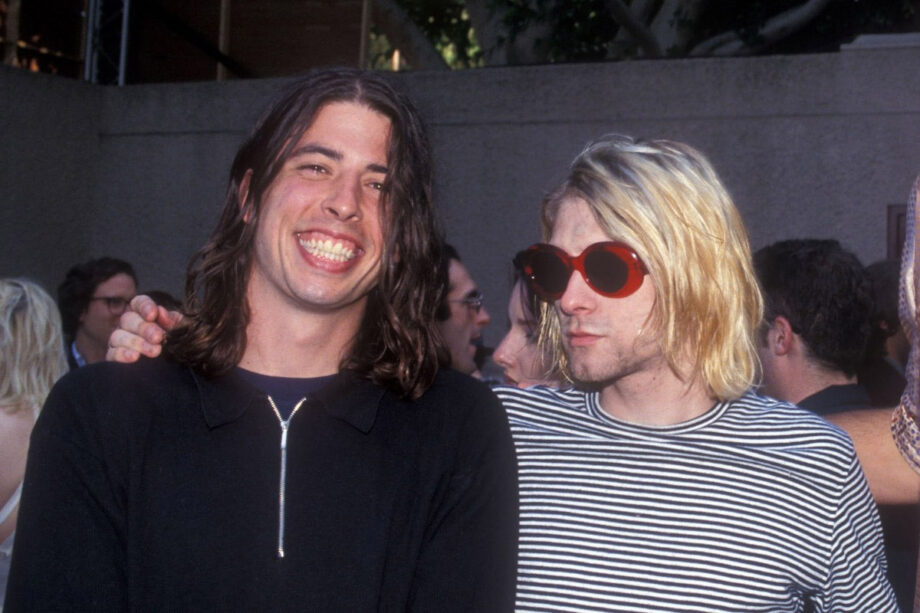
Dave Grohl recently discussed his Nirvana era, stating that “Smells Like Teen Spirit” is not the band’s best single and revealing his top picks from the album, in a feature published by Mojo.
The musician recalled the early writing and rehearsal process for the Nevermind album in Washington. “We wrote Smells Like Teen Spirit in January or February of 1991,” Grohl said. “We’d been rehearsing in this shed behind someone’s house in Tacoma, Washington. The guy who owned it played in a covers band, a bar band, and he rented out this rehearsal space with a home-made 8-track studio and we rehearsed there for three or four months and that’s where a lot of Nevermind was written.”
Grohl explained that he initially expected other tracks on the album to be the standout hits. “With Nevermind, I thought In Bloom was going to be the ‘smash hit’ off the record, or Lithium,” he continued. “I thought Smells Like Teen Spirit was just another album cut. We recorded it pretty quickly, and I think it was one of [producer] Butch Vig’s favourites, and it soon became pretty clear that it would be the special song on the record. But, of course, at that point we didn’t think anything was going to happen with the record.”

He noted that the band had modest expectations for the single’s success and television exposure. “I thought Teen Spirit might get on [MTV’s] 120 Minutes and allow us to tour with Sonic Youth, but no one thought it was a hit single because [that] was just unimaginable,” Grohl said. “I mean the funniest part was seeing the video on MTV. We were touring America just as the album came out in September of ’91, playing places that held maybe 200-300 people, and we’d go back to the hotel and turn on the TV and see our video and go, That’s so funny, we’re on TV, and we’ve just played [legendary ‘DC hardcore venue] the 9:30 Club, or whatever! Then with the video came more people and the clubs got bigger and bigger.”
The tour quickly grew in scale, surpassing anything Grohl had experienced with his previous bands. “The [proper] tour started in Toronto at the Opera House and it seemed like a fairly typical Nirvana gig: there were maybe 500 or 600 people there,” he recalled. “To me, you have to remember that was like making it, going from the 32 people who would usually come to see [Grohl’s pre-Nirvana band] Scream in every city to, like, 500 people, I considered that to be the greatest success of my entire life! But the capacity of a lot of the gigs that we were playing on that tour were low – we played a place in Portland, Maine or maybe Vermont where the legal capacity was 67, a tiny little living room of a place, it was chaotic.”
As the music video gained traction on MTV, the atmosphere at their live shows changed dramatically. “When the video hit MTV it made a big difference,” Grohl explained. “That’s when you’d show up to a 500-capacity gig and there were 500 extra people there. We were still in our little bubble – we were in our van, the three of us, Krist’s wife Shelli, our monitor guy Miles, and Monty Lee Wilkes, our tour manager – and it didn’t seem like anything unusual was happening until we’d get to the gig and it was fucking chaos. And we started to notice there were normal people here, what are they doing here? That guy looks like a jock, what the f*ck is he doing here? And it was like, Oh, maybe that video thing is attracting some… riff-raff! The only indication that our world was turning upside down would be when you’d get to the venue. Then it would be, Holy shit, these people are nuts!”

While acknowledging the song’s cultural impact, Grohl concluded that it does not rank as the band’s finest work. “Teen Spirit definitely established that quiet/loud dynamic thing that we fell back on a lot of the time,” he said. “It did become that one song that personifies the band. But the video was probably the key element in that song becoming a hit. People heard the song on the radio and they thought, ‘This is great,’ but when kids saw the video on MTV they thought, ‘This is cool. These guys are kinda ugly and they’re tearing up their fucking high school!’ So I think that had a lot to do with what happened with the song. But do I think it’s the greatest single of all time? Of course not! I don’t even think it’s the greatest Nirvana single. And compared to Revolution by The Beatles or God Only Knows by The Beach Boys?! Give me a break! Smells Like Teen Spirit was a great moment in time… but there’s better.”
Dave Grohl’s take on Nirvana’s catalog adds a fresh twist to one of rock’s most familiar stories. His comments are a reminder that the band’s biggest songs were part of a much larger run of releases that turned Nevermind into a breakthrough record.
“Smells Like Teen Spirit” peaked at No. 6 on the Billboard Hot 100, while Nevermind was selling 400,000 copies a week by Christmas 1991. The single also hit No. 1 on the Modern Rock Tracks chart and was certified platinum in April 1992.
That commercial surge helped push Nirvana from cult status to mainstream dominance. Nevermind reached No. 1 on the Billboard albums chart the same week “Smells Like Teen Spirit” peaked at No. 6 on the Hot 100.
Grohl’s point about other Nirvana songs as possible “smash hits” also fits the album’s release history. “Lithium” was released as Nevermind’s third single in 1992 and reached No. 64 on the Hot 100, “In Bloom” arrived later that year as the fourth and final single and reached No. 5 on the Mainstream Rock chart.
Both songs came from the same recording sessions that made Nevermind such a defining album. Nirvana recorded the album with producer Butch Vig at Sound City Studios in Van Nuys, California, in May and June 1991, after earlier work at Smart Studios in Madison, Wisconsin.
That production gave the record a cleaner, more radio-friendly sound than Nirvana’s earlier releases. Vig recalled that the band arrived at the studio prepared and intense, with a sense of urgency that shaped the sessions from the start.