

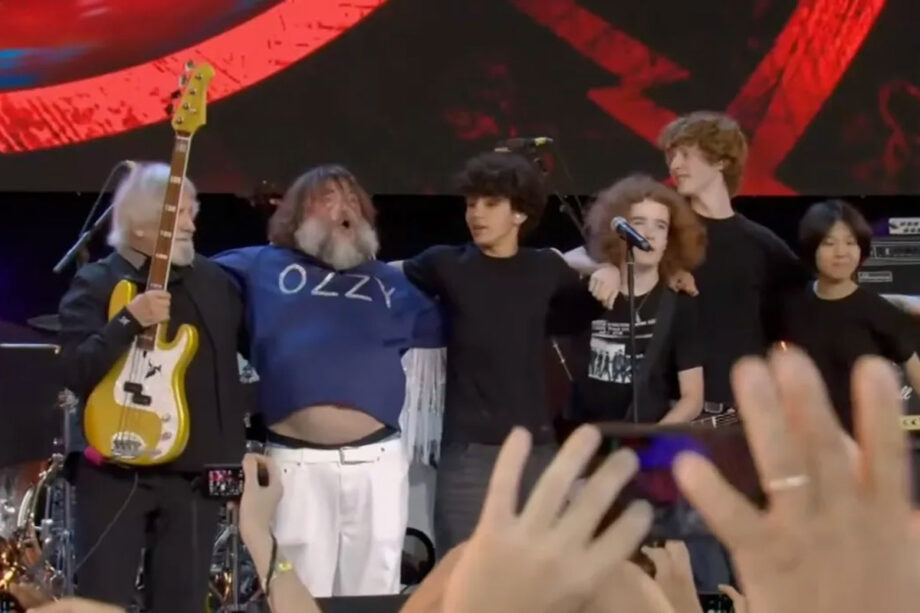
Jack Sabbath’s set at Tom Morello’s Power To The People festival was more than a novelty cameo. It was a staged tribute tied to the event’s political and generational theme, held at Merriweather Post Pavilion on 3 October 2026. The day was built around activism, community and classic rock crossover.
The band played a short set drawn from Black Sabbath and Ozzy Osbourne. It included “Mr. Crowley,” “The Wizard” and “War Pigs,” with Geezer Butler joining for the last song. That made the slot feel symbolic: a celebrity-fronted tribute backed by real Sabbath lineage, not a parody.
The set landed inside a festival full of high-profile guests and a free livestream. That helped it become one of the day’s crossover moments. Jack Sabbath worked as a bridge between legacy metal, mainstream rock and a crowd spanning several generations.

The backing band — Roman Morello, Revel Ian, Yoyoka Soma and Hugo Weiss — gave the performance a young, tight feel. The playing mattered as much as the joke. These were teenage musicians handling classic Sabbath songs with enough confidence to make the tribute believable.
The set was built on real songs and a real guest turn from Butler, not a loose sketch. That is why it landed as a genuine live moment rather than a comedy bit for the cameras.

The festival drew a large, star-packed crowd, and Black’s appearance became one of the day’s talking points. The free stream carried the set far beyond the venue.
Curiosity drove much of the attention, as much as nostalgia did. The real hook was seeing a Black Sabbath tribute planted inside a politically branded festival.
The staging leaned on contrast: Jack Black, a teenage band and Butler’s guest spot. It was built to work both in the pavilion and on screen, and it became one of the day’s shareable highlights.
Detailed accounts of the mix and sound are still thin, and no clear verdict on audio quality has formed. Even so, the set stood out on a crowded bill.
Jack Sabbath matters because it treats classic metal as something younger players and pop-culture figures can still reshape. The slot was announced as part of a festival built on cross-generational collaboration, and that context shapes how it reads.
The show worked because it balanced reverence and accessibility: enough Sabbath authenticity for metal fans, enough personality for casual viewers, and enough festival framing to feel current rather than nostalgic. The moment that stays is Butler walking out for “War Pigs,” a founding member of Black Sabbath flanked by a comedian and four teenagers.